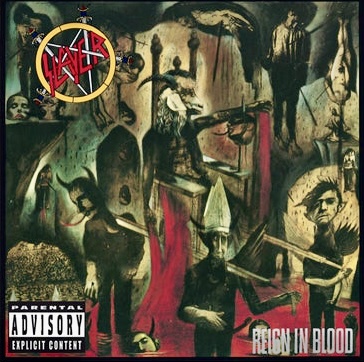
The cheerful album cover for “Reign in Blood” by the thrash-metal band Slayer
Today, we continue the saga of that little-known troubadour, Tommy Treacle. The Jan 25, 2025 blog post exposed his failed commercial attempts to produce horror film themes in the 1970’s. As the 1980’s matured, the many genres and subgenres of heavy metal music began to morph and multiply at an astonishing rate. Mr. Treacle found this to be fertile ground for song re-interpretation. In a rare interview with Metal Mania Magazine in 1987, he explained that his initial interest in the project was based on an inability to clearly discern the lyrics of speed and thrash-metal songs. He decided to slow it all down with folk-style arrangements in an attempt to broaden the appreciation for the lyrical elements. This was generally met, by the bands and their rabid fans, with vicious invective that included extreme profanity, colorful threats of death and dismemberment, bursts of saliva (and other unnamed secretions), as well as actual bodily violence. He was stripped naked and nearly lost a testicle at a bowling alley in Dayton, Ohio (it was found 1/2 block away near a Shoney’s and successfully reunited with its owner). He has since stated that time will bear out his unorthodox approach and that it was “all worth it in the end.” On the above track, you will hear a portion of Slayer’s song “Necrophobic” from that same album, followed by Tommy Treacle’s altered arrangement. Please enjoy.
Heartfelt words to live by. My new necro-nihilistic mantra!
“The modern Republican Party is comprised of those who well remember our sordid past and, through both negligence and malfeasance, have condemned us to repeat it.”
— modified quote from george santayana
Mike “Dip-Shit” Johnson (R-Louisiana, Vichy district) places his left hand on the Bible and swears an official oath to “always use my right hand to solemnly jerk-off President Trump in whatever location or time of day, with whatever grip, using whatever hand pressure, either with or without lubricant, eye contact or otherwise, so as to best serve my President and not the country, so help me God.”
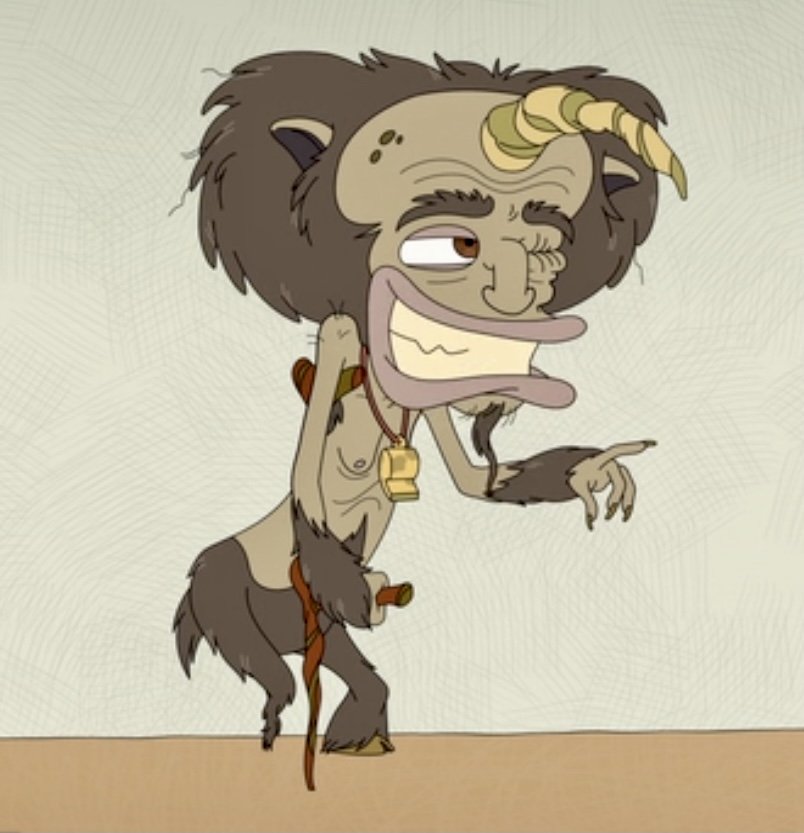
The MAN:Coach Steve from “Big Mouth” (voiced by Nick Kroll)Rick, the coach’s decrepit hormone monster (voiced by Nick Kroll), encourages with, “you da man, Steve!” And, yes, his nose is shaped like a penis…
“It’s Simple Steve” (1980) by Herbert Siguenza at the Smithsonian American Art Museum
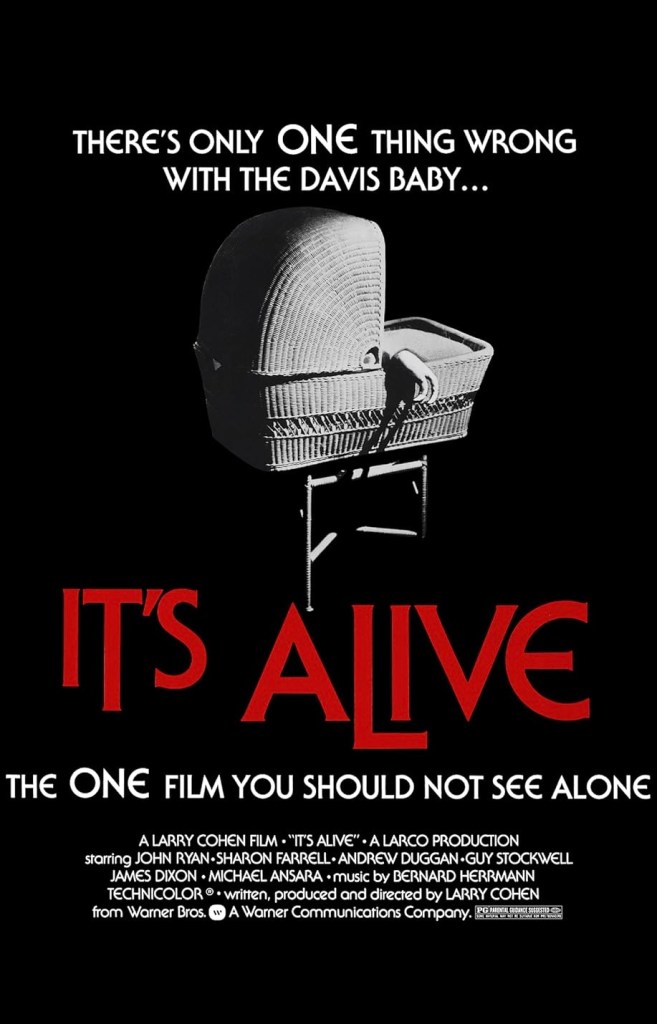
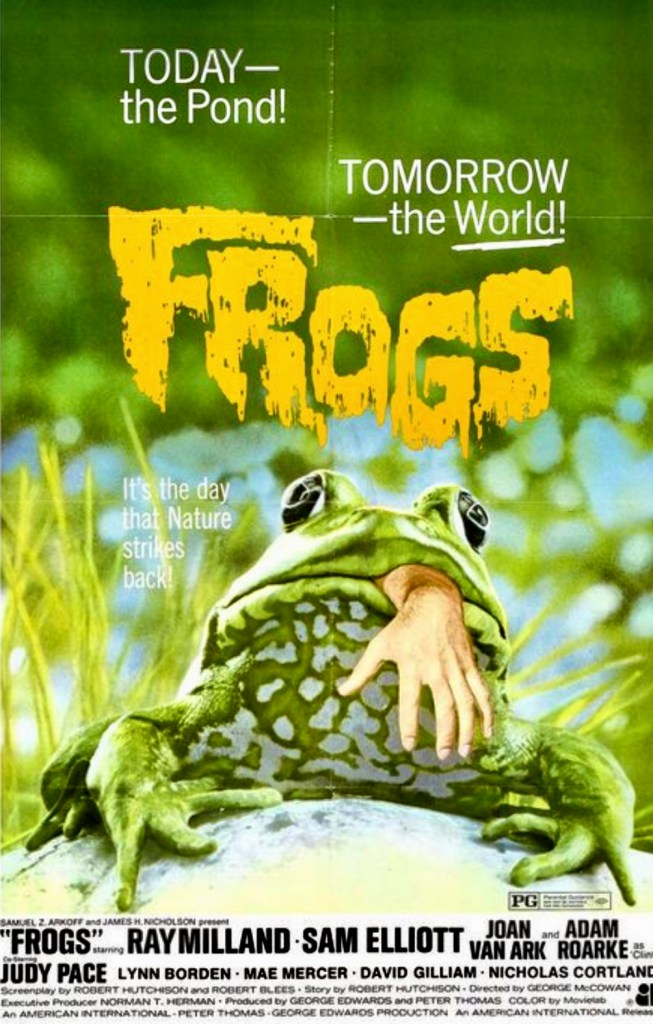
What follows is a little known story in Hollywood circles that I feel compelled to share. During the spate of fantastical horror films in the 1970’s, there was a folk troubadour who made the rounds from Universal to MGM to Warner Bros. to United Artists and back. He called himself Tommy Treacle and said he hailed from back east, though details of his life are sparse. He carried a weather-beaten acoustic guitar and always wore a tattered brown tee-shirt with the visage of Jim Croce, therein telegraphing his musical leanings (he also sported a tattoo that just say “Hey”). He would quietly pitch his songs as potential themes, with a special predilection for fright-films, saying he wanted to “pour a sack of sugar into Tinseltown’s bottomless vat of vinegar” (he called it the “treacle-down” effect). In this blog post, I present three of his songs that were summarily rejected by the studios as being wildly inappropriate to both mood and theme. It was said that on being dismissed, he would just smile, shoulder his guitar, and whistle a strange tune — one described as being somehow both bright and mournful — as he climbed into his orange El Camino with vanity plates exclaiming LOVE to the wide wide world. In all three audio clips, you will hear the film trailer followed by Mr. Treacle’s proposed theme song. Enjoy (rated PG).
I consider the 70’s to be the highpoint of the horror film trailer. I was totally freaked by the preview for “Alien” (1979). The one for “It’s Alive” was enough to keep me away from the theater (although I think that had more to do with it being a knock-off of “Rosemary’s Baby”). Now they seem mostly funny and so totally over-the-top, but in the best possible way. “Frogs” was an incredibly lame attempt at horror as environmental warning, even if prescient. Co-incidentally, my sister’s nickname is Frog, which she fully embraces, and it arose from her showing early expertise at swimming the breaststroke. She has numerous celebratory frog tchotchkes and keepsakes at home, mostly gifts. My wife, on the other hand, cannot stand the croaking of frogs and gets semi-freaked out when I threaten to play the above film trailer. Alas, there’s room in this weird world for both extremes and all those in-between. That’s, at least, what Tommy Treacle would say.
Growing up in the DC area, it was a right of passage to walk up and down the infamous “Exorcist steps” at the western end of Georgetown (near Dixie Liquor!). If memory serves, I did it once with some friends and found it a bit anti-climactic. However, at a certain time of day, you might see the Georgetown crew team spiritedly running up and down those stairs, which sounds truly demonic. Come to think of it, those stairs may have been the actual cause of death of Father Merrin (played by Max von Sydow), who was shown earlier in the film taking nitroglycerin for his heart condition. You see, everything converges in the end. And aren’t we all, for each other and on every given day, exorcists?!
“The Sixth of January” (modeled on the English folk poem “The Fifth of November” that commemorates Guy Fawkes’ so-called “Gunpowder Treason” on Nov 5, 1605)
Fix in your memory!
The sixth of January,
The Trump Tower Treason and plot;
I know of no reason
Why the Trump Tower Treason
Should ever be forgot!
Donald and his companions
Did scheme and contrive,
To blow Congress and Constitution
All up alive.
The former was spared
Yet the question remains,
If the latter, hereafter,
Can ever survive.
One of many versions of the traditional English folk poem
I’m wishing you all the continued success you have had in your long and blusterous career. That is to say, I hope you remain an utter and colossal failure. May your final personal humiliation be our collective national redemption! At which time, you will join the other raging-bullies who have stomped the world stage before you, and, through manipulation and lies and corruption and unholy alliances (as well as the abetting cowardice of those within your own, chosen, party), have risen to such Icarian heights. They, too, “won” the game of power. So please enjoy today’s moment of “triumph” before you slide down history’s sleazy and slimy slope, the one greased with blood, pus, vinegar and snake venom. And then you will be fully ensconced in the Pantheon of Ignominy, at the Hall of Half-Hitlers, to rub elbows with the likes of Franco, Marcos, Amin, Gaddafi and Pinochet. Our very own Mobster Baron. The Buffooner-in-Chief. Perhaps you are just the oily emetic (or else cathartic suppository) that we need, at this critical inflection point, to rid our body politic of its Medieval black bile. Do your worst, you gilded piece of mediocre horseshit… and then, in the immortal words of Logan Roy, FUCK OFF!!
Is it considered a “found object” in the artful sense if it’s discovered in your own old boxes?
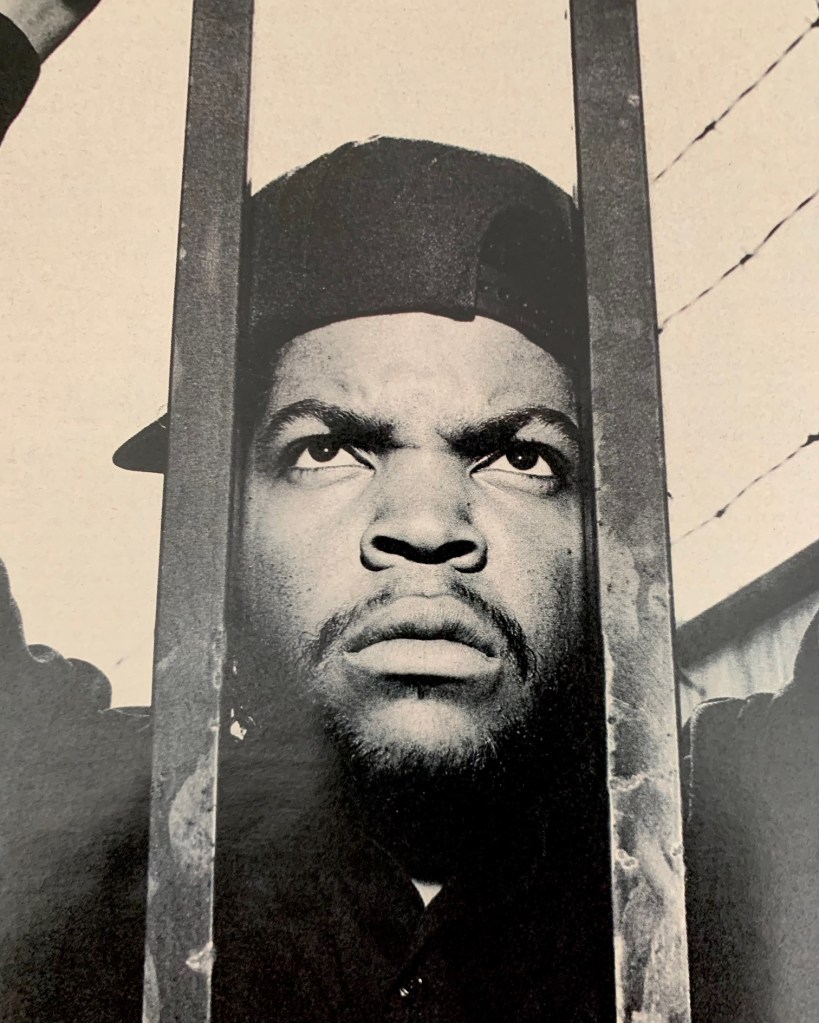
Being 26 y/o at the time, I’ve no doubt why I purchased this Oct 1990 issue of Rolling Stone. Three reasons, in fact. Oddly enough in retrospect, I was never a subscriber. I think I felt that the magazine’s best days were past. I did, however, subscribe to CMJ New Music Monthly and Q Magazine for the music recommendations (they gifted me early warnings on Neko Case, American Analog Set, Franz Ferdinand and Sparklehorse). And yet somehow none of those copies survived, while I did manage to hang onto this artifact across the 34 years and 12 home moves, most of that time without a storage unit. Recently unearthed, I wanted to share some of the images in this little time-capsule. ..
The answer is, no, I never owned Duck Head pants. Not that I wouldn’t have worn them, as I’ve been seen in worse… recently.
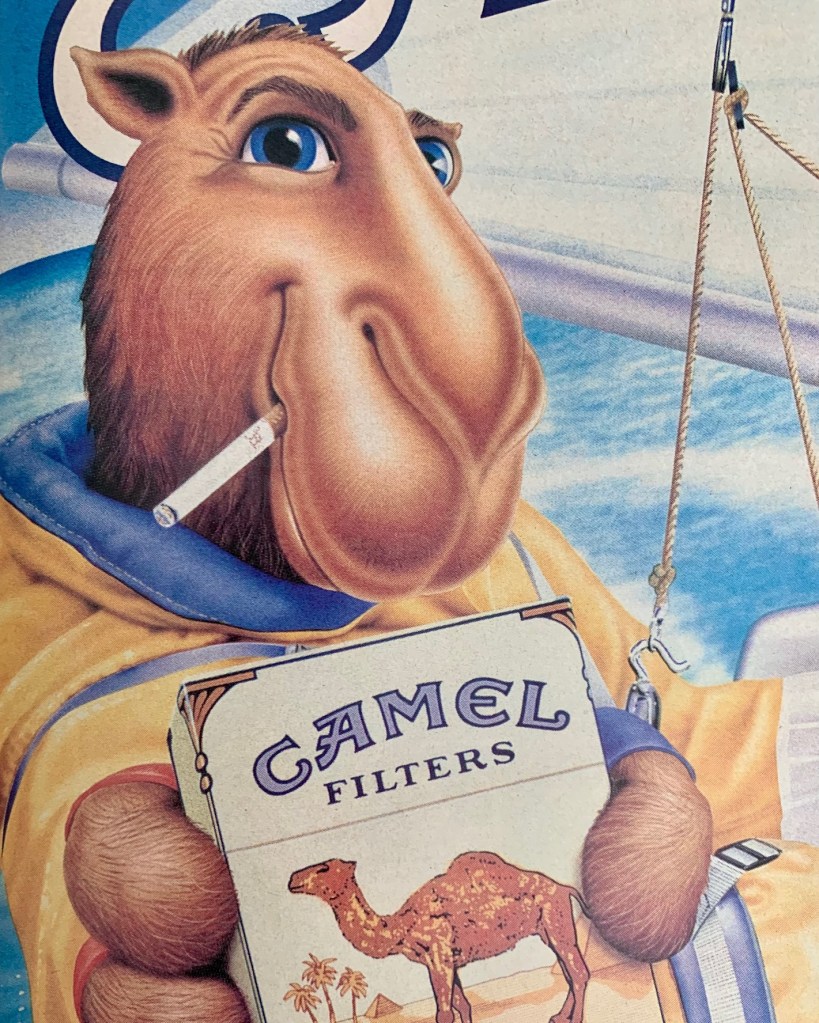
Perhaps more than the feature articles, the advertisements seem to capture the vibe of those days. It’s the frisson of amused and semi-disgusted recognition. Like an unflattering photo of your younger self, caught wrong-footed. Reminds you of all the really bad stuff you fell for and/or bought. Any 8-track tape. Pants with pleats. Top-siders. The Stones album “Dirty Work” (1986). That beer can collection. The beaded car seat cushion. I could go on…
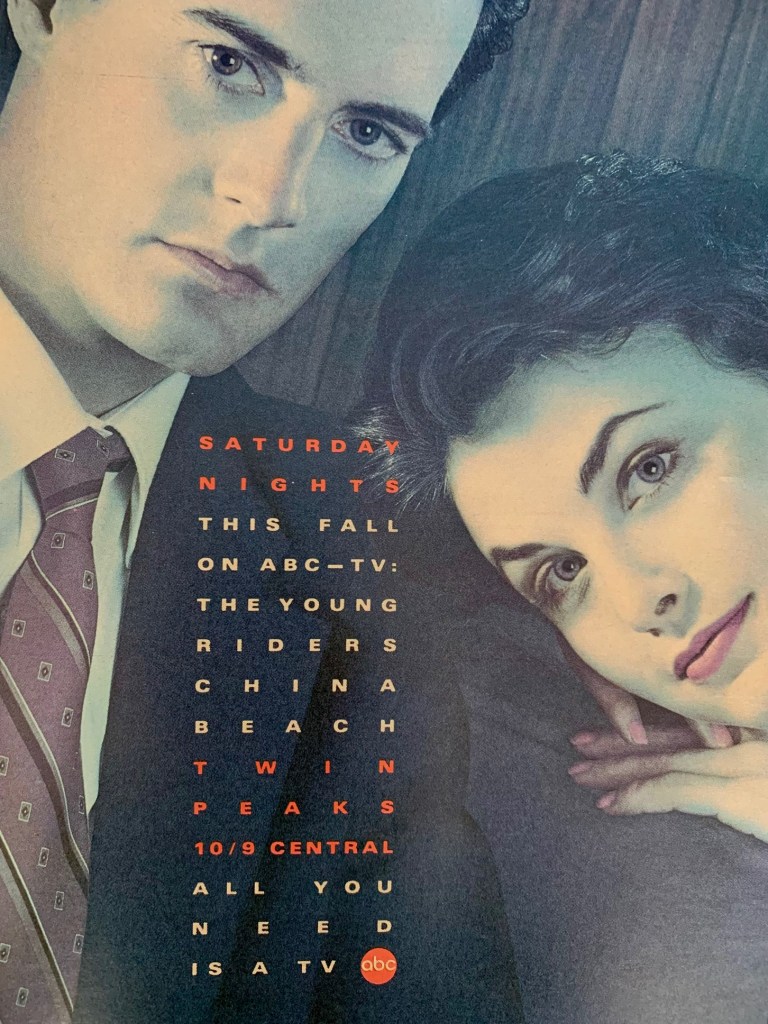
And why is it that bad jokes are so easy to remember? My friend Mike, if you hit your golf ball into a bunker, would invariably exclaim, “China Beach!” It never got old because it was always old. But we all could agree that Dana Delany was, and probably still is, as that very same Mike would say, a “smoke show”! TV, thankfully, started to get a little weirder in the 80’s and early 90’s. ESPN launched in 1979 (ESPN2 in 1993). The sports news was initially pretty sparse, so they used supplemental material like strongman competitions and Australian Rules Football (“Footy”). In the latter case, our mid 80’s college boredom was transiently salved by picking teams and trying, unsuccessfully, to figure out the scoring system (later explained to me by an Aussie while on an overnight ferry from Calais to Dover). My adopted team was Geelong. The stadium cheer I conjured up was half the crowd yelling “GEE-” and the other side responding “-LONG” (fucking brilliant!). MTV started in 1981. Later would come “The Simpsons” and “Beavis and Butthead” when things really started to bend. But, as with bad jokes, some of the most memorable TV shows are the ones you found cloying/annoying, like “30 Something” and “Friends.” Just fucking shoot me…
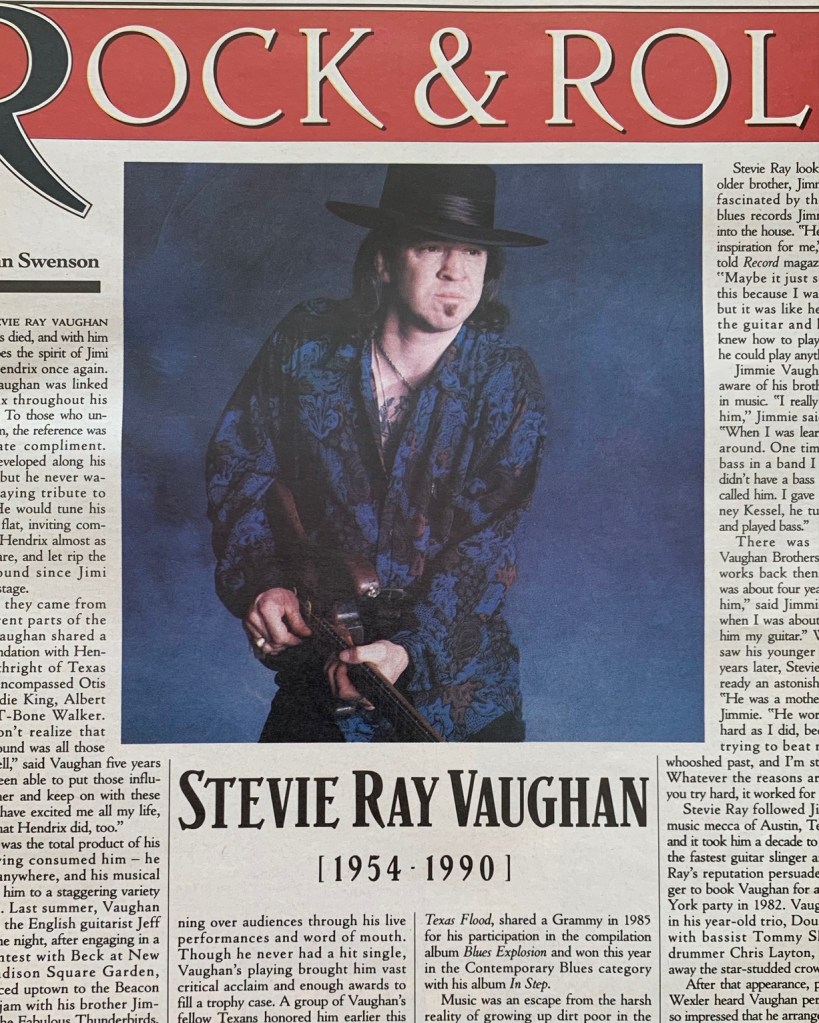
There were also standouts to the upside like the surrealist “Twin Peaks”, and it is only fitting that we honor the great David Lynch who very recently passed away (for my money, “Elephant Man” is his magnum opus, followed closely by “Mulholland Drive”). A moment of silence, please…
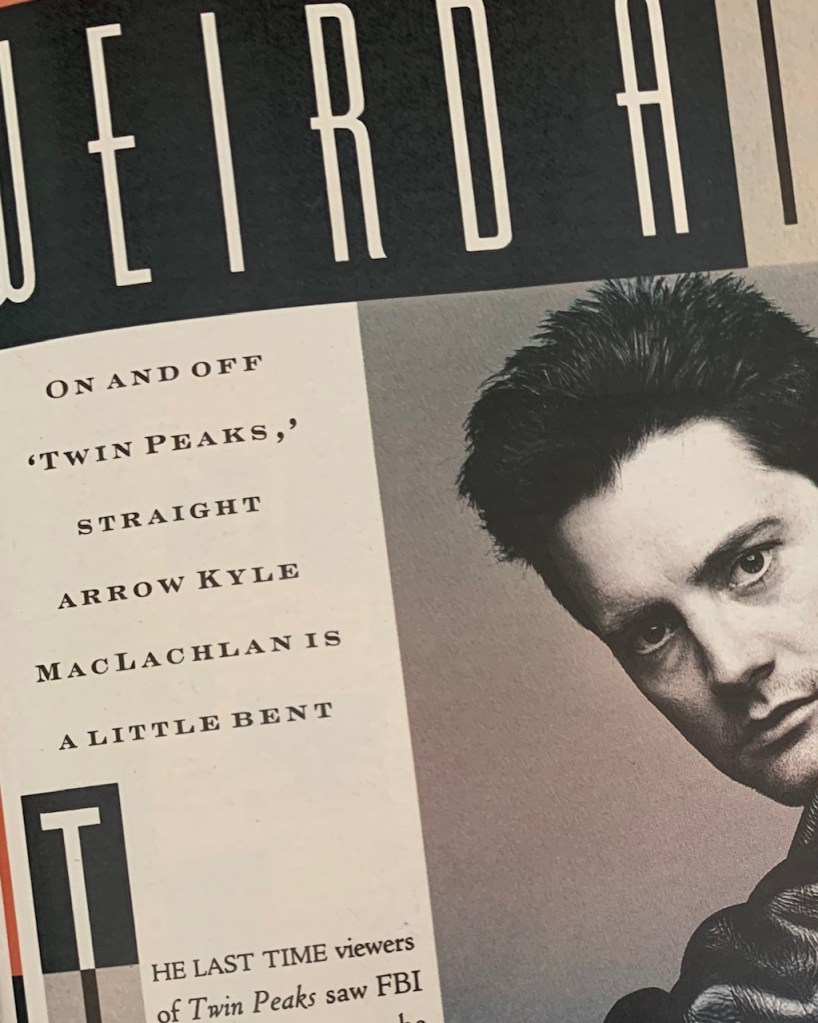
It wasn’t all ads, of course. But while I mostly enjoy Kyle MacLachlan’s work, I never got comfortable with his role on “Sex and the City.” Just sayin’…
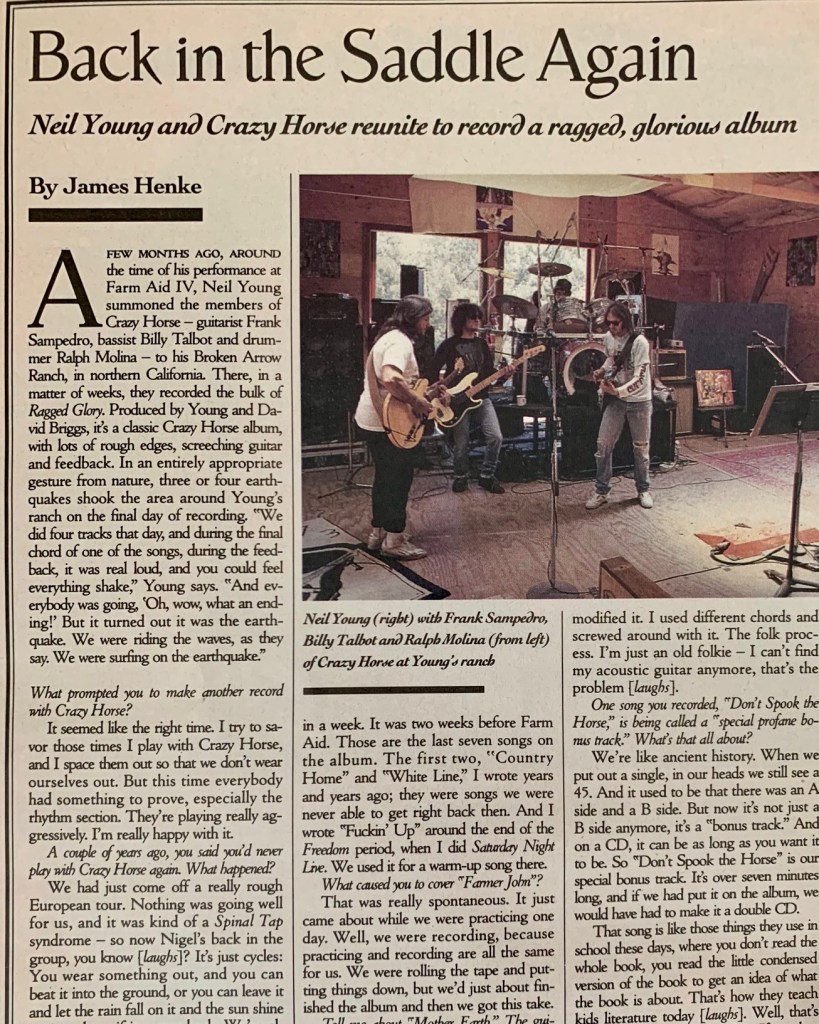
New albums by Neil Young, with or without Crazy Horse, are always welcome! And there’s a song on Ragged Glory that I’ll sing to myself when I’ve made some stupid, unforced error: “Why do I keep fuckin’ up…??” (and if you’re interested, the track is called, ahh, “Fuckin’ Up”). Try it…!!
In life, there’s always a mix of good and bad news. A yin for every yang. Saw a great musical play about Curtis Mayfield in Chicago years ago. Man, he had such a healing voice…
Yup…
The only thing constant is change…
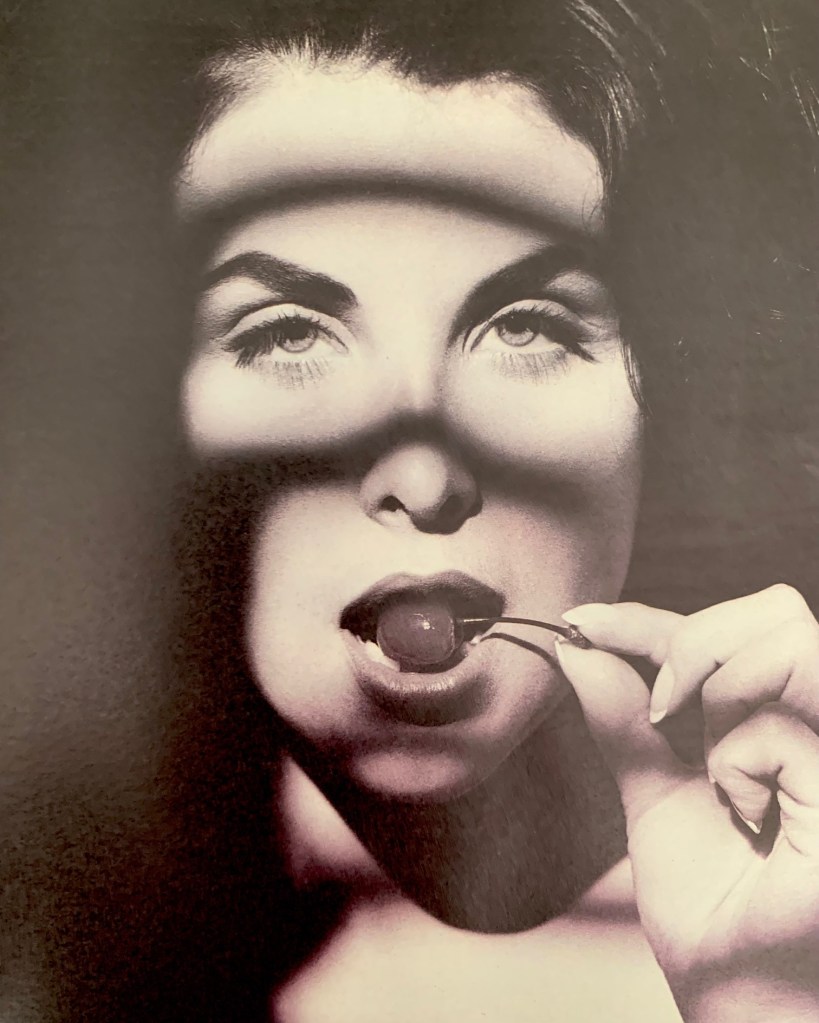
Miss, are you gonna finish that cherry?…
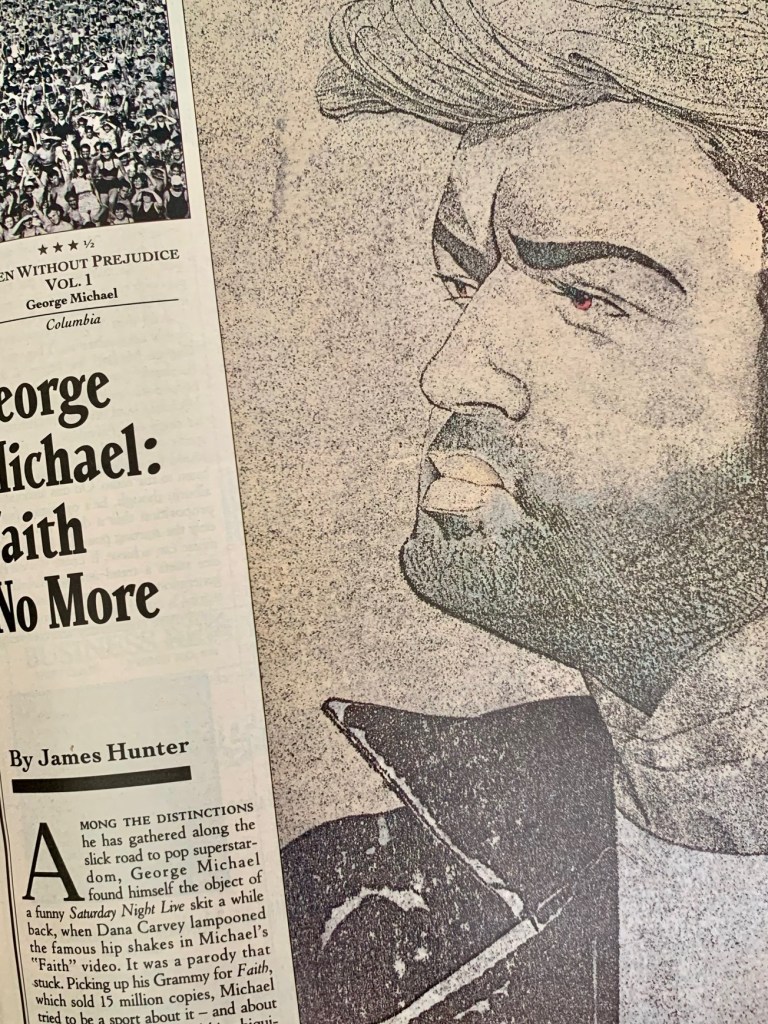
The Netflix documentary about WHAM! is quite good. But this post has turned a tad funereal…
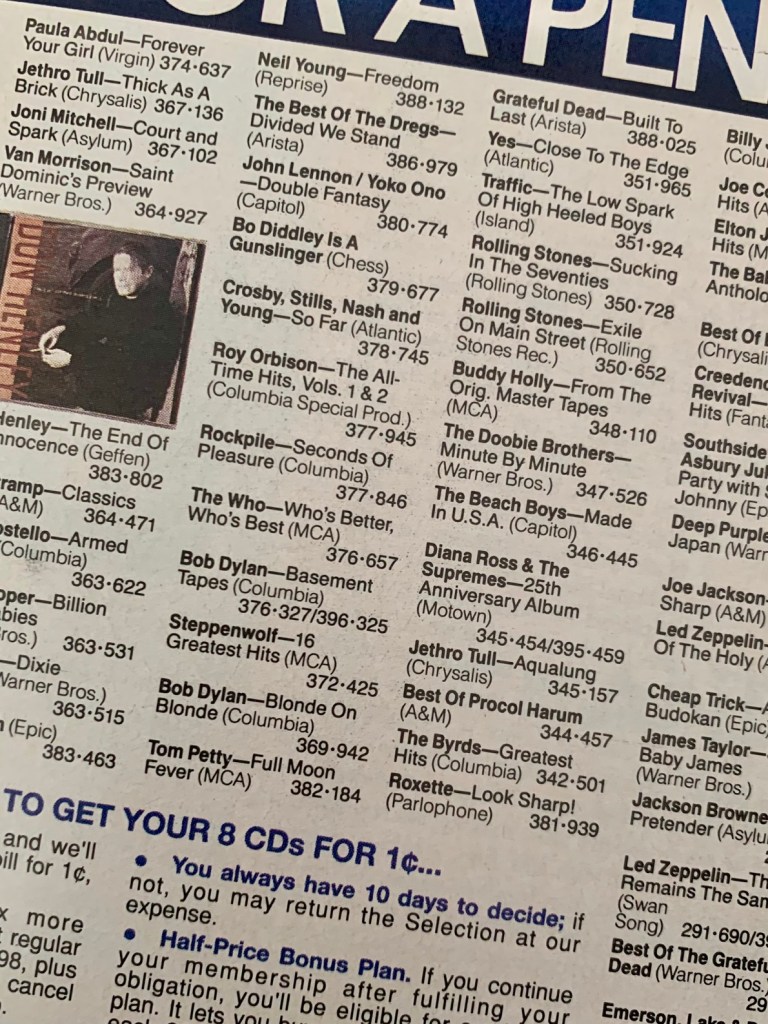
I must have joined these CD clubs half a dozen times (and still have the discs!). But there was never a time, ever, when I would spend even one bloody-red-fucking-cent for Don Henley’s “The End of the Innocence” album. Utter shite…
Top Five: Mariah Carey, MC Hammer, Anita Baker (I do like her!), Poison, and Wilson Phillips. I’ve recently been thinking that popular music has gotten much worse in the last 30 years. Now I’m not so sure…
Music’s future was in our past…
(Richard Branson in an ad for GAP) Remember the good old days when our corporate oligarchs were jovial adventurers and had no plans to subvert democracy from unelected positions? How quaint…