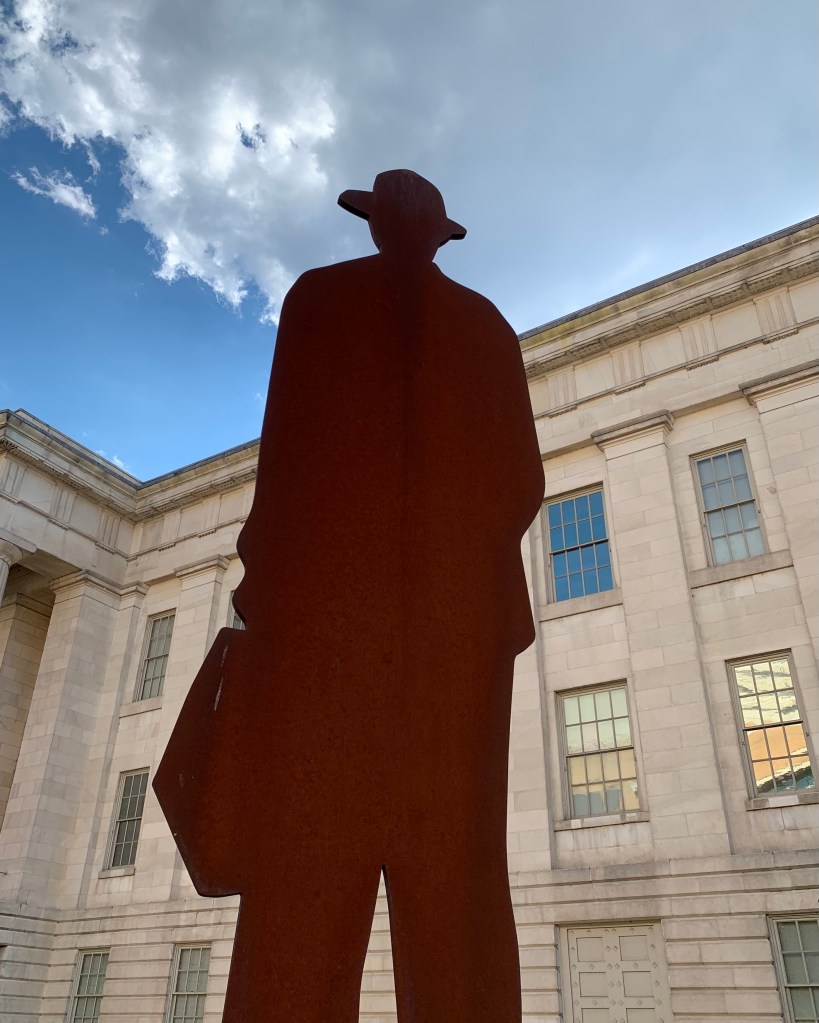
“The Quiet Man”

National Portrait Gallery , Washington, DC in May 2021

Our maternal grandmother volunteered as a docent at the National Portrait Gallery when we were young. She used to gather my middle sister and I for her gallery tours, often depositing us for a spell in the kid’s area. The space was called the Discovery Room or something similar. It was terrific. You could run around and touch the objects. There were cool reflective surfaces and tunnels. Things would light up on contact. A magical place. Sadly, it’s gone now (was thinking I’d love to go back in time to cement the imagery, but on second thought maybe it’s better left in that warm attic space of memory). Sometimes we would accompany her tour groups and stand at the back. Years later, she fondly recalled us mimicking her dignified delivery in front one of our favorites: “Grant and His Generals” (below). I remember how much she loved Andrew Wyeth, Edward Hopper, and Alexander Calder, and so I love them deeply, too. She set us on a course of art appreciation and exploration that will last a lifetime. For that, and for her unbounded kindness, we are forever grateful.

“Grant and His Generals” by Ole Peter Hansen Balling at The National Portrait Gallery in Washington, DC

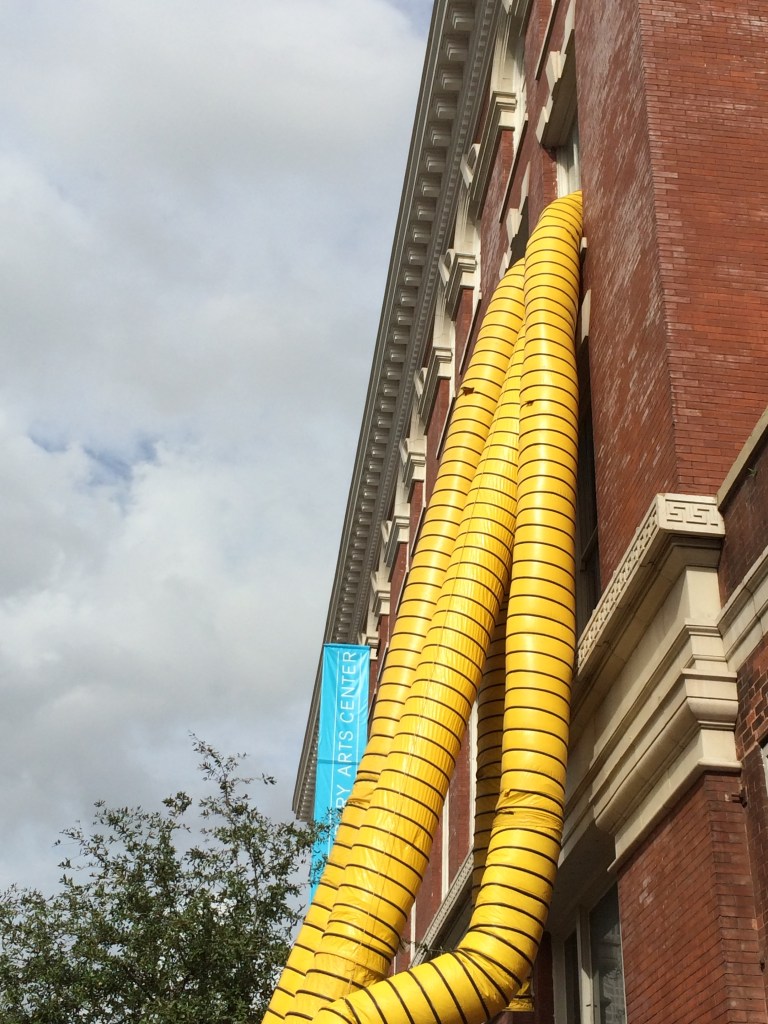
“Outsider Art”

NOLA November 2014

My immediate reaction to this scene was to recall the duct motif in one of my favorite films, Terry Gilliam’s dystopian satire “Brazil” (1985). His absurdist Orwellian nightmare only seems to gain in relevance as the decades pass: the insinuating tendrils of corporate and state surveillance encroach; the molder of our infrastructure deepens; the stain of consumerist materialism expands; the need for romantic escape from reality (ironically through “reality TV” and life-like video-games) grows ever more dire. And this image, taken outside the Contemporary Arts Center in New Orleans, also makes a comment on our bloated art market. Objects of wonder reduced purely to their monetary value with barely a mention of historical context, aesthetic appeal, technique, or emotional impact. They are selling Banksy, but they aren’t reading him. And so these ducts might have conveyed the detritus of soulless works by a Damien Hirst or Jeff Koons, who were no doubt commenting — opportunistically — on these very same commercial sensibilities. But in the end, we get progressive dilution. All shock, no awe. And in so doing they cynically fuel that market churn, as Warhol did more artfully before them (Duchamp, in contrast, remains elevated as the skewering iconoclast. Instead of selling out, he opted for chess), until the overly borrowed becomes the ever banal.

How much do you think I can get for that photo?…….

“Eureka!”

Sagittal T1 spin-echo MR image of the brain with linear artifact.

The exclamation “Eureka!” (per Wikipedia) is attributed to Archimedes. It is a transliteration of the Greek word heureka, meaning “I have found it!” He reportedly made this spontaneous utterance when stepping into a bath and suddenly he realized that the volume of water displaced must be equal to the volume of the body part submerged. Those were “heady” days. In modern times, it is sometimes associated with the sudden urge to vacuum….

“Ode To Ogden’s Eels”

“I like unagi, except when soggy” — SF

Ogden Nash’s light verse was some of the first poetry I encountered as a kid. My parents had a lovely bound collection of his works that has since been passed on to me. I tended to go for the shorter ones, since I wasn’t much of a reader back then. Here’s the inspiration for my poem above:

“I don’t mind eels, except as meals” — Ogden Nash