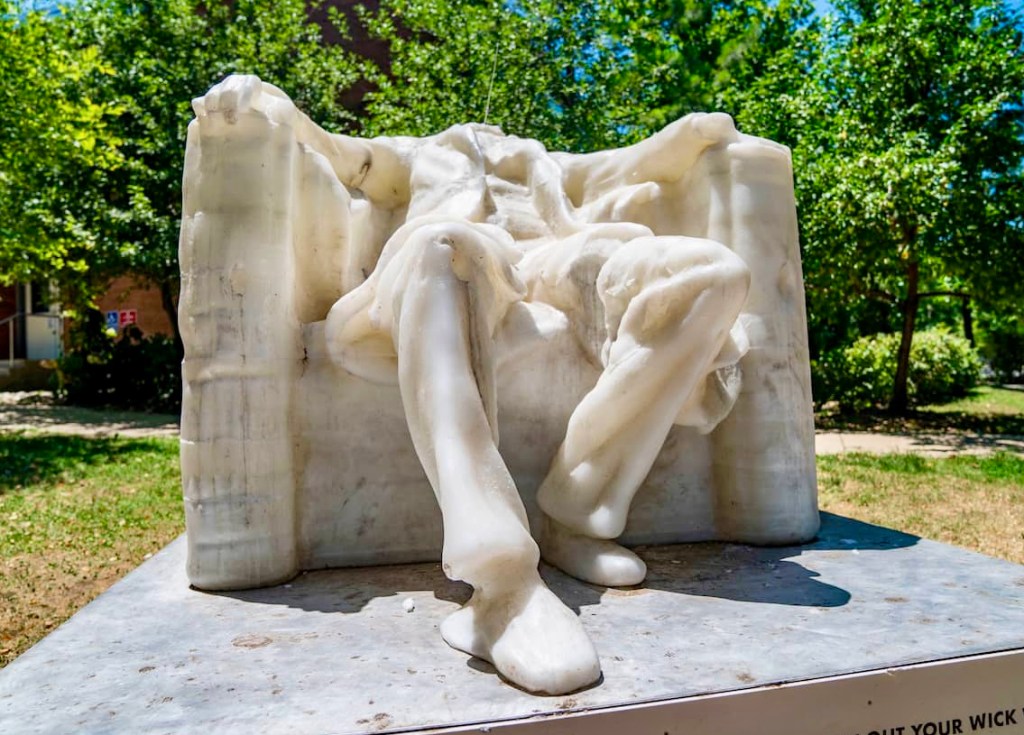
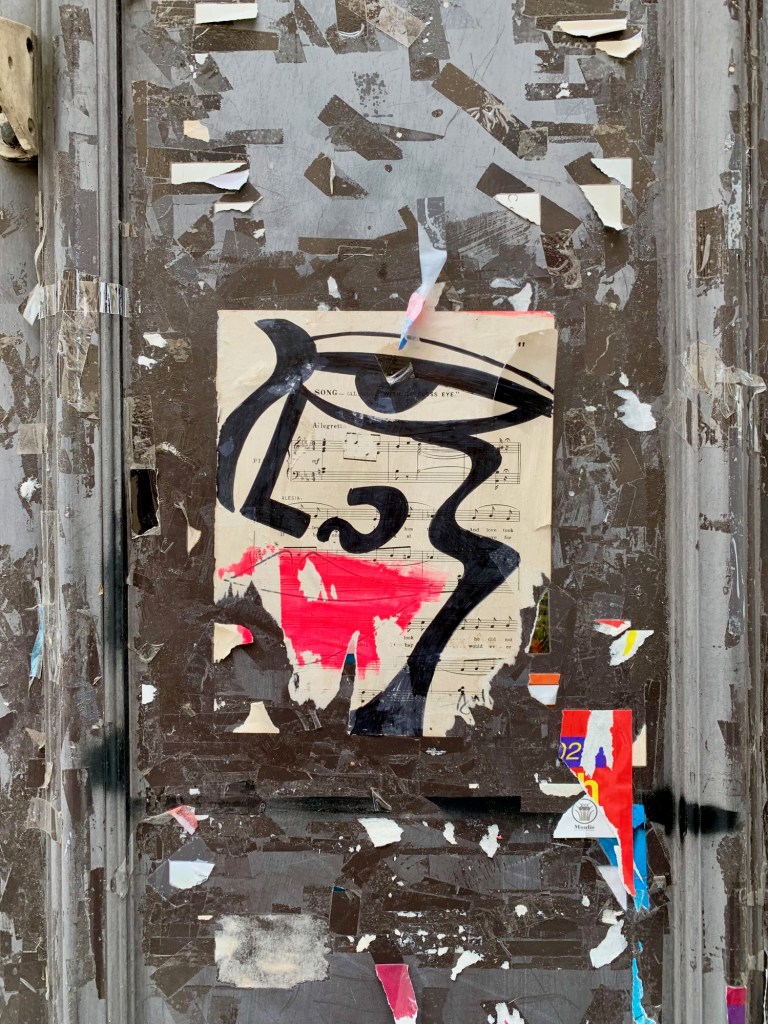
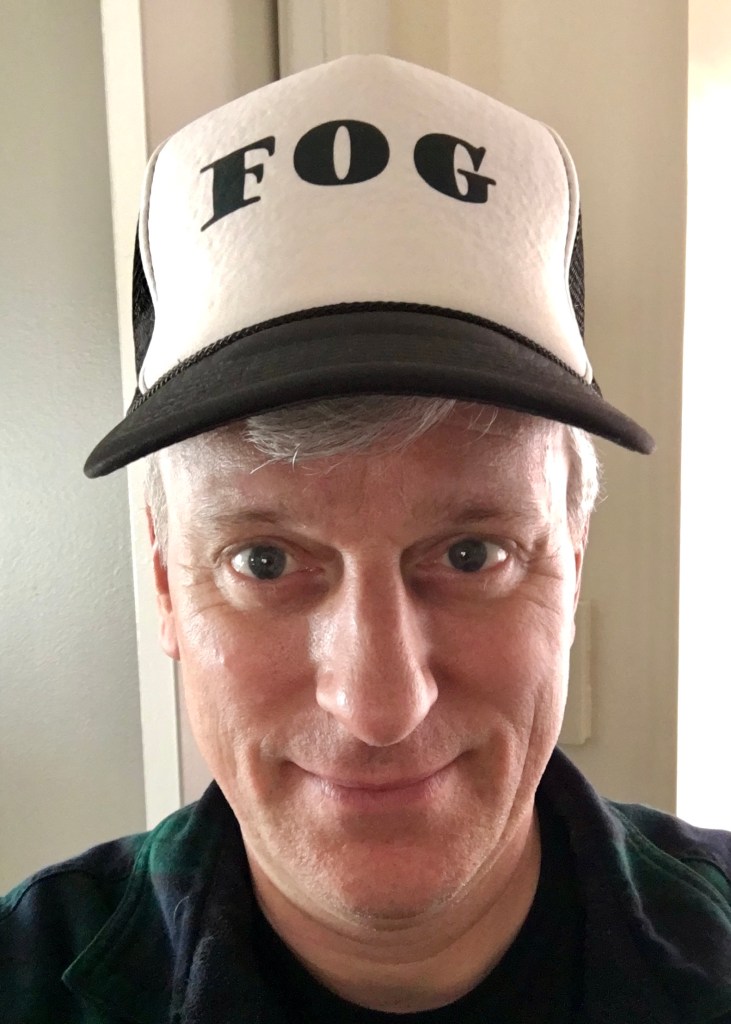
I’d call it “The Headless Statesman.” Wax statue of Abraham Lincoln, by artist Sandy Williams IV, melted in the severe summer heat of Washington, DC (GETTY IMAGES, June 2024). This is how my head feels today after we re-elected a vile, soulless, anti-democratic sociopath to our highest office. Donald Trump, the HEEDLESS Statesman. Well done, America, you fucking BOZO!!
It’s impossible to overstate the distaste I have for the American electorate right now. All of our guardrails have utterly failed in preventing this felonious, self-dealing, deranged, soul-rotted, maggot-brained sexual abuser from re-entering the White House. There are so many moral cowards and enablers who share this blame that I haven’t the time nor space to name them all: the heavily partisan and plainly unethical SCOTUS majority providing cover and delaying legitimate legal cases against him — along with other Trump-appointed bench lackeys like Aileen Cannon ; Mitch “Machiavelli” McConnell and his gang of political brigands including Lindsey Graham, Mike Johnson, and Marco Rubio, just to name a few (it’s power at any cost for these mediocre supplicating weasels); the mendacious/alarmist right-wing press of FOX and Murdock and Elon Musk (via X) and fellow-traveler douchebags like Joe Rogan who whitewash the blood and bile from Trump’s faux orange skin. The list goes on and on…
But finally it was the goalkeeping electorate who fell down. They watched the original screen version of Trump 1.0 in full Technicolor, Sensurround, and Smell-O-Vision and have now said, “Sequel, please!” They heard all the lies, the smears, the taunts, the threats, the illogic, the misinformation, the lack of historical knowledge, the absence of decorum and civility, the lack of empathy, the selective outrage, the corrosion of our vital institutions, etc., etc.,… and still pressed the Trump button. Yes, there were some prominent voices on the Right who spoke against the dangers, but they were all too few, said way too little, and came well too late. The best chance to finish off his sordid political career, surely, was at the second impeachment trial over the Jan 6 insurrection. But the spineless Republicans in the Senate collapsed under the weight of their moral and political responsibility, most likely out of fear of Trump’s base. And now we the voters, having been collectively riveted by the unhinged Trump attempt to subvert an election (while he himself cheered on the violence perpetrated on our Capitol by his own followers) based on a pure fabrication of voter fraud, have decided to give him a full 4-year do-over (no doubt the notorious golf cheat, with a supposed single-digit handicap, takes unlimited mulligans). And maybe that gets to the heart of the matter: what too many Americans crave is an entertaining political conflict, one with the frisson of violence, that rolls from town to town like professional wrestling/UFC. They want blood sport, not nuanced policy debate. Trump gives them that version of escapism on steroids and HGH, even if he’s cynically undermining their own interests in the process. And they also find Trump somehow “funny” with his malicious slurs and belittling nicknames (that, in the manner of all bullies, are far more accurate when pointed straight back at him). They literally and figuratively want their own “Gladiator” (Trump in this analogy, of course, runs much closer to the evil character of Commodus). Well perhaps his timing couldn’t be any better because, coming soon to your local theater, is “Gladiator II.”
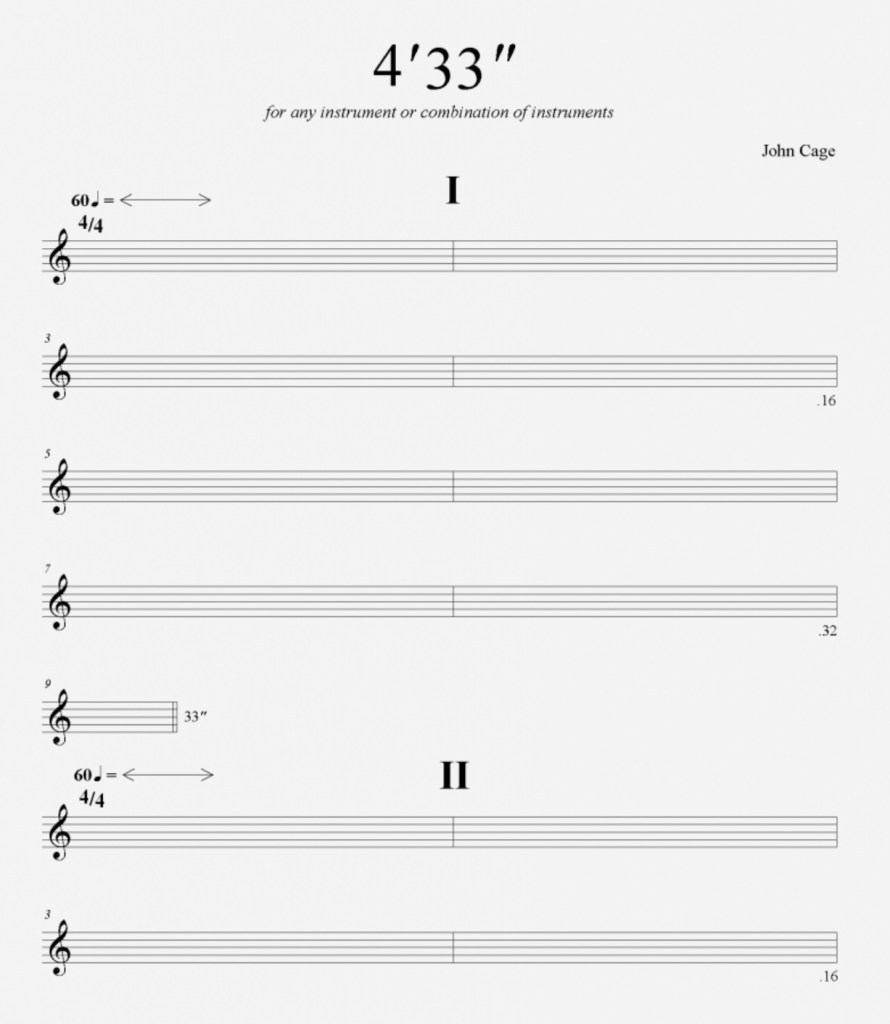
It seems that music underlies most things in this life. Even traffic. I once read that the universe gives off a low hum that corresponds to a Bb note, emanating from a black hole 250 million light years away (but it is inaudible at 57 octaves below middle C). God must play trumpet. And one could say that John Cage‘s “silent” modernist composition called 4’33” is in that key, by inference. Here’s Cage on the reception of the first performance of the piece in 1952 (from Wikipedia):
“They missed the point. There’s no such thing as silence. What they thought was silence, because they didn’t know how to listen, was full of accidental sounds. You could hear the wind stirring outside during the first movement. During the second, raindrops began pattering the roof, and during the third the people themselves made all kinds of interesting sounds as they talked or walked out.”
This is more like the sound immediately after I play at open mic…
The colors in a successful painting are said to harmonize. Champagnes are rumored to give a signature sound if you put an ear to the glass (and this may prove more soothing than compositions by Philip Glass). There’s often music in poetry, at least the ones I like best, and sometimes more so than in actual music. Then again, atonal music has its own history. My noise may be your music and vice-versa. That’s all fine, just turn it down a bit… And I once had the luck to catch the multi-instrumentalist Jon Brion in LA at the Coronet Theater. Amazing performer. He stopped mid-show to take a song request and after countless shout-outs, I called (from the Group W bench) a counterintuitive one for laughs, Arlo Guthrie‘s Thanksgiving epic “Alice’s Restaurant (Massacree)” that lasts 18:34. Much to my surprise and delight, he played it for a minute or two before throwing in the towel. So, so cool. And legend has it that he once flung open the venue’s side door to sample street construction noises for an improvised composition. Now that’s the stuff! My guess is the tune was in Bb.
Finally, a few thought on music from Walt Whitman in his “Leaves of Grass” (1855):
“All music is what awakens from you when you are reminded by the instruments,
It is not the violins and the cornets… it is not the oboe nor the beating drums — nor the notes of the baritone singer singing his sweet romanza… nor those of the men’s chorus, nor those of the women’s chorus,
A clever mash-up of Nixon and Trump (from the web, circa 2016). The former secretly scuttled Vietnam War peace talks in 1968 to gain the White House, only to resign under the burgeoning Watergate scandal. The latter dodged the draft with phantom heels spurs, lies incessantly, was twice impeached, and continues to subvert democracy with election denialism, racism, and by stoking hatred and political violence. Trump thereby gains the improbable yet dubious honor of, by comparison, somehow rehabilitating the sordid Nixon Administration.
The title of this blog post is a reference to the poem “The Cure at Troy” by Seamus Heaney. Its most famous fragment was quoted by Bill Clinton in 1995 at Derry/Londonderry, Northern Ireland during the ongoing peace process (the Good Friday Agreement came in 1998):
“History says, don’t hope On this side of the grave. But then, once in a lifetime The longed-for tidal wave Of justice can rise up, And hope and history rhyme.”
But it was another poem that recently caught my eye and had me connecting Trump to Nixon — and to many other demagogues of various stars, bars, and stripes — like a metastasizing cancer infiltrating nodal stations across all time and space. “August 1968” was written by W.H. Auden and is a distilled reflection on power and oppression that, in present day, would well tolerate the alternate title: “The Idiot Trump”… and here’s hoping we dump that irredeemable sack of maggot-infested goat shit, that bloviating brain-pox of imbecilic bull-shittery, that feculent scourge of bilious and toxic nonsense — once and for all — on Nov 5, 2024!
August 1968:
“The Ogre does what ogres can, Deeds quite impossible for Man, But one prize is beyond his reach, The Ogre cannot master Speech: About a subjugated plain, Among its desperate and slain, The Ogre stalks with hands on hips, While drivel gushes from his lips.”
The Kool-Aid crowd on the Christian Right have come to see the lying, cheating, thieving, racist libertine and quasi-fascist that is Trump as some sort of anointed deliverer from God above (who not only works in mysterious ways but also has a really fucked-up sense of humor!). And this all makes perfect sense. Birds of a feather, as they say, flock together. Frauds seek out and recognize other frauds in order to perpetuate even greater fraud (and further pack an already fraudulent Supreme Court). Different game, same graft. This seeming dark/light paradox is actually a balanced equation, a marriage of convenience, designed to maximize leverage and profits. In my moments of agitated pessimism, it is a third poem — one by William Butler Yeats called “The Second Coming” — that puts Trump’s rise in a slightly different biblical light…
The Second Coming:
“Turning and turning in the widening gyre The falcon cannot hear the falconer; Things fall apart; the centre cannot hold; Mere anarchy is loosed upon the world, The blood-dimmed tide is loosed, and everywhere The ceremony of innocence is drowned; The best lack all convictions, while the worst Are full of passionate intensity. Surely some revelation is at hand; Surely the Second Coming is at hand. The Second Coming! Hardly are those words out When a vast image out of Spiritus Mundi Troubles my sight: somewhere in sands of the desert A shape with lion body and the head of a man, A gaze blank and pitiless as the sun, Is moving its slow thighs, while all about it Reel shadows of the indignant desert birds. The darkness drops again; but now I know That twenty centuries of stony sleep Were vexed to nightmare by a rocking cradle, And what rough beast, its hour come round at last, Slouches towards Bethlehem to be born?“
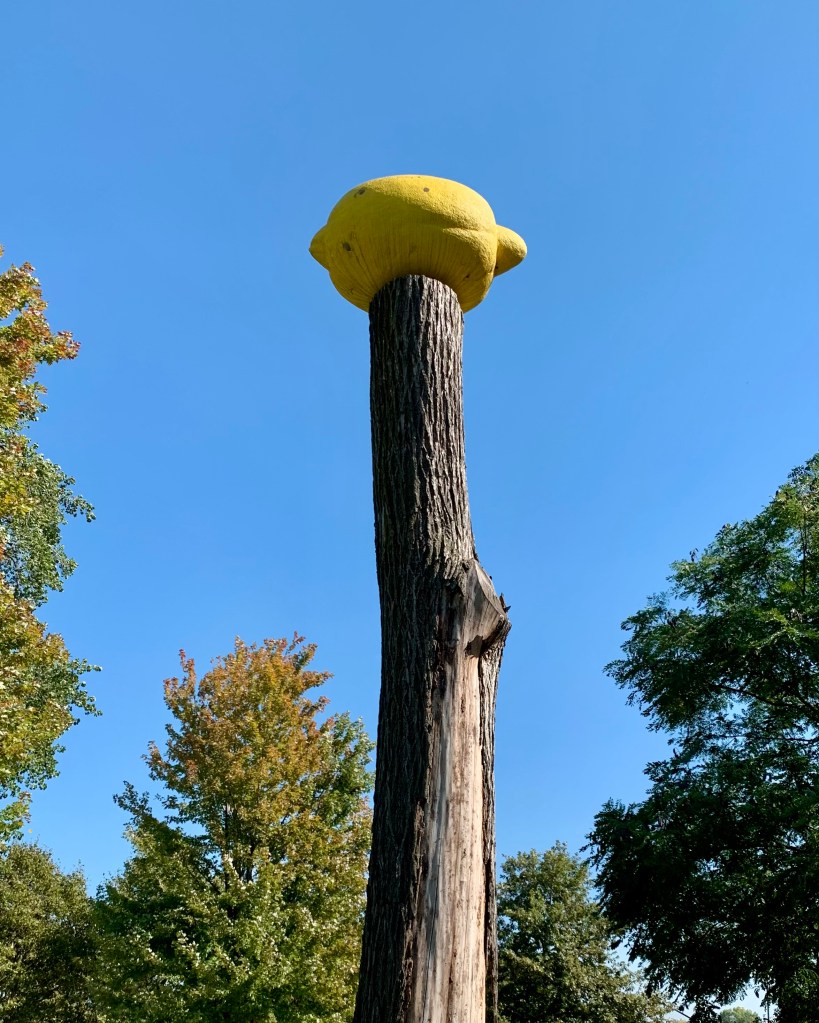
This artwork in Lincoln Park (Chicago, IL) by Irene Hoppenberg is called “Lemon Tree” (2019). The artist describes it as a comment on climate change as part of the Chicago Tree Project. Some locals are bitter about it…