“Music Everywhere…”

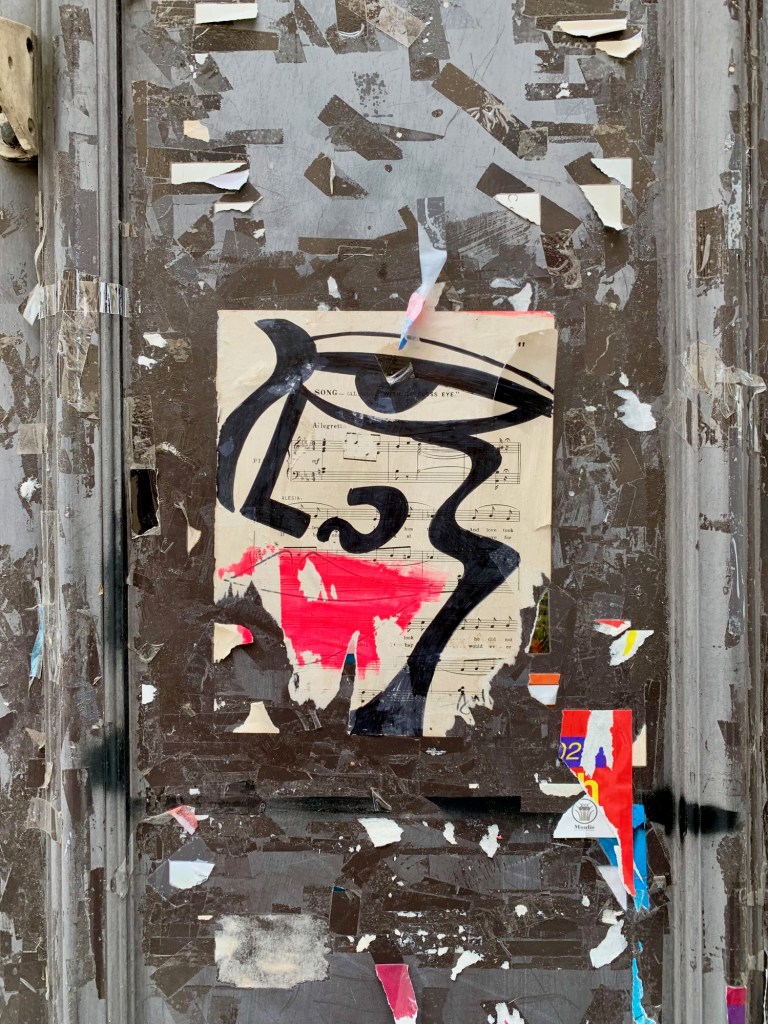
A tuneful poster wall in Paris (Sept 2024)

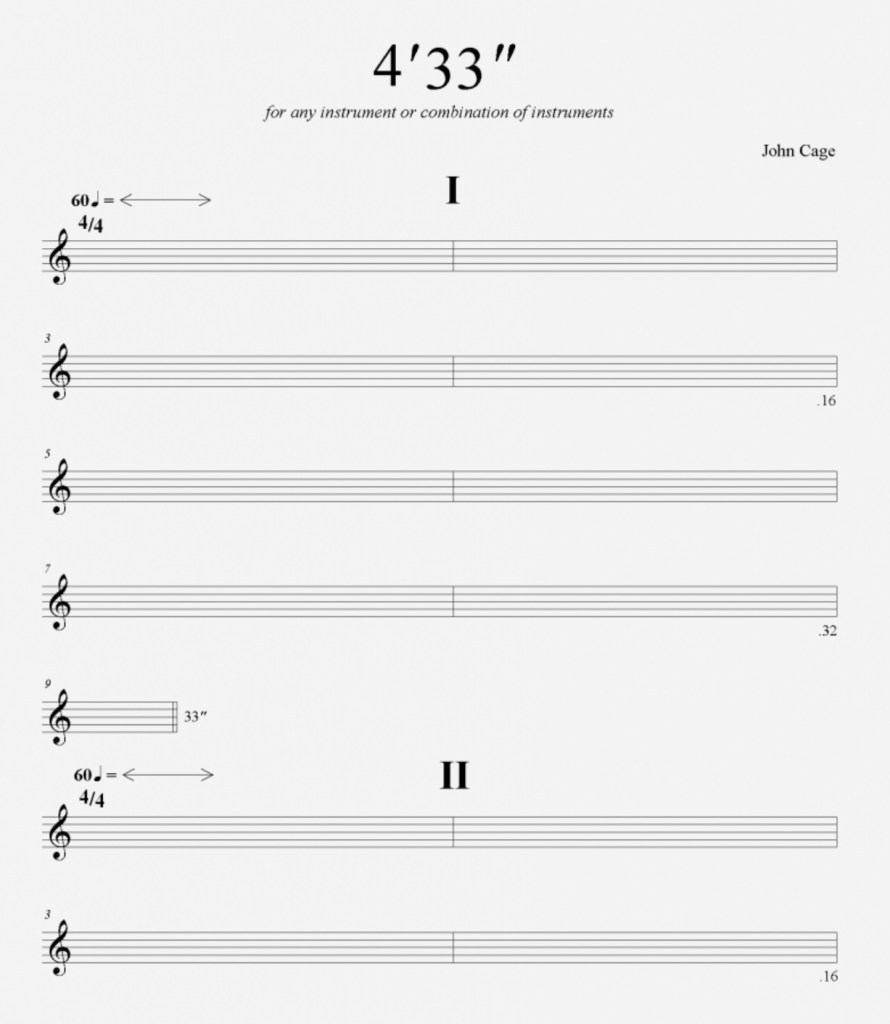
It seems that music underlies most things in this life. Even traffic. I once read that the universe gives off a low hum that corresponds to a Bb note, emanating from a black hole 250 million light years away (but it is inaudible at 57 octaves below middle C). God must play trumpet. And one could say that John Cage‘s “silent” modernist composition called 4’33” is in that key, by inference. Here’s Cage on the reception of the first performance of the piece in 1952 (from Wikipedia):

“They missed the point. There’s no such thing as silence. What they thought was silence, because they didn’t know how to listen, was full of accidental sounds. You could hear the wind stirring outside during the first movement. During the second, raindrops began pattering the roof, and during the third the people themselves made all kinds of interesting sounds as they talked or walked out.”
This is more like the sound immediately after I play at open mic…

The colors in a successful painting are said to harmonize. Champagnes are rumored to give a signature sound if you put an ear to the glass (and this may prove more soothing than compositions by Philip Glass). There’s often music in poetry, at least the ones I like best, and sometimes more so than in actual music. Then again, atonal music has its own history. My noise may be your music and vice-versa. That’s all fine, just turn it down a bit… And I once had the luck to catch the multi-instrumentalist Jon Brion in LA at the Coronet Theater. Amazing performer. He stopped mid-show to take a song request and after countless shout-outs, I called (from the Group W bench) a counterintuitive one for laughs, Arlo Guthrie‘s Thanksgiving epic “Alice’s Restaurant (Massacree)” that lasts 18:34. Much to my surprise and delight, he played it for a minute or two before throwing in the towel. So, so cool. And legend has it that he once flung open the venue’s side door to sample street construction noises for an improvised composition. Now that’s the stuff! My guess is the tune was in Bb.

Finally, a few thought on music from Walt Whitman in his “Leaves of Grass” (1855):

All music is what awakens from you when you are reminded by the instruments,

It is not the violins and the cornets… it is not the oboe nor the beating drums — nor the notes of the baritone singer singing his sweet romanza… nor those of the men’s chorus, nor those of the women’s chorus,

It is nearer and farther than they.

“Rhymes of Hope and History”

A clever mash-up of Nixon and Trump (from the web, circa 2016). The former secretly scuttled Vietnam War peace talks in 1968 to gain the White House, only to resign under the burgeoning Watergate scandal. The latter dodged the draft with phantom heels spurs, lies incessantly, was twice impeached, and continues to subvert democracy with election denialism, racism, and by stoking hatred and political violence. Trump thereby gains the improbable yet dubious honor of, by comparison, somehow rehabilitating the sordid Nixon Administration.

The title of this blog post is a reference to the poem “The Cure at Troy” by Seamus Heaney. Its most famous fragment was quoted by Bill Clinton in 1995 at Derry/Londonderry, Northern Ireland during the ongoing peace process (the Good Friday Agreement came in 1998):

“History says, don’t hope
On this side of the grave.
But then, once in a lifetime
The longed-for tidal wave
Of justice can rise up,
And hope and history rhyme.”

But it was another poem that recently caught my eye and had me connecting Trump to Nixon — and to many other demagogues of various stars, bars, and stripes — like a metastasizing cancer infiltrating nodal stations across all time and space. “August 1968” was written by W.H. Auden and is a distilled reflection on power and oppression that, in present day, would well tolerate the alternate title: “The Idiot Trump”… and here’s hoping we dump that irredeemable sack of maggot-infested goat shit, that bloviating brain-pox of imbecilic bull-shittery, that feculent scourge of bilious and toxic nonsense — once and for all — on Nov 5, 2024!

August 1968:

“The Ogre does what ogres can,
Deeds quite impossible for Man,
But one prize is beyond his reach,
The Ogre cannot master Speech:
About a subjugated plain,
Among its desperate and slain,
The Ogre stalks with hands on hips,
While drivel gushes from his lips.”

The Kool-Aid crowd on the Christian Right have come to see the lying, cheating, thieving, racist libertine and quasi-fascist that is Trump as some sort of anointed deliverer from God above (who not only works in mysterious ways but also has a really fucked-up sense of humor!). And this all makes perfect sense. Birds of a feather, as they say, flock together. Frauds seek out and recognize other frauds in order to perpetuate even greater fraud (and further pack an already fraudulent Supreme Court). Different game, same graft. This seeming dark/light paradox is actually a balanced equation, a marriage of convenience, designed to maximize leverage and profits. In my moments of agitated pessimism, it is a third poem — one by William Butler Yeats called “The Second Coming” — that puts Trump’s rise in a slightly different biblical light…

The Second Coming:

Turning and turning in the widening gyre
The falcon cannot hear the falconer;
Things fall apart; the centre cannot hold;
Mere anarchy is loosed upon the world,
The blood-dimmed tide is loosed, and everywhere
The ceremony of innocence is drowned;
The best lack all convictions, while the worst
Are full of passionate intensity.
Surely some revelation is at hand;
Surely the Second Coming is at hand.
The Second Coming! Hardly are those words out
When a vast image out of
Spiritus Mundi
Troubles my sight: somewhere in sands of the desert
A shape with lion body and the head of a man,
A gaze blank and pitiless as the sun,
Is moving its slow thighs, while all about it
Reel shadows of the indignant desert birds.
The darkness drops again; but now I know
That twenty centuries of stony sleep
Were vexed to nightmare by a rocking cradle,
And what rough beast, its hour come round at last,
Slouches towards Bethlehem to be born?

“Ogden’s Nash-ings”

The hardened heart that’s seeking cure
Is salved by joyful laughings.
So health insurer’s should procure
A whopping dose of Ogden’s Nash-ings
.”

— My own homage to Ogden nash
The man, the pith.

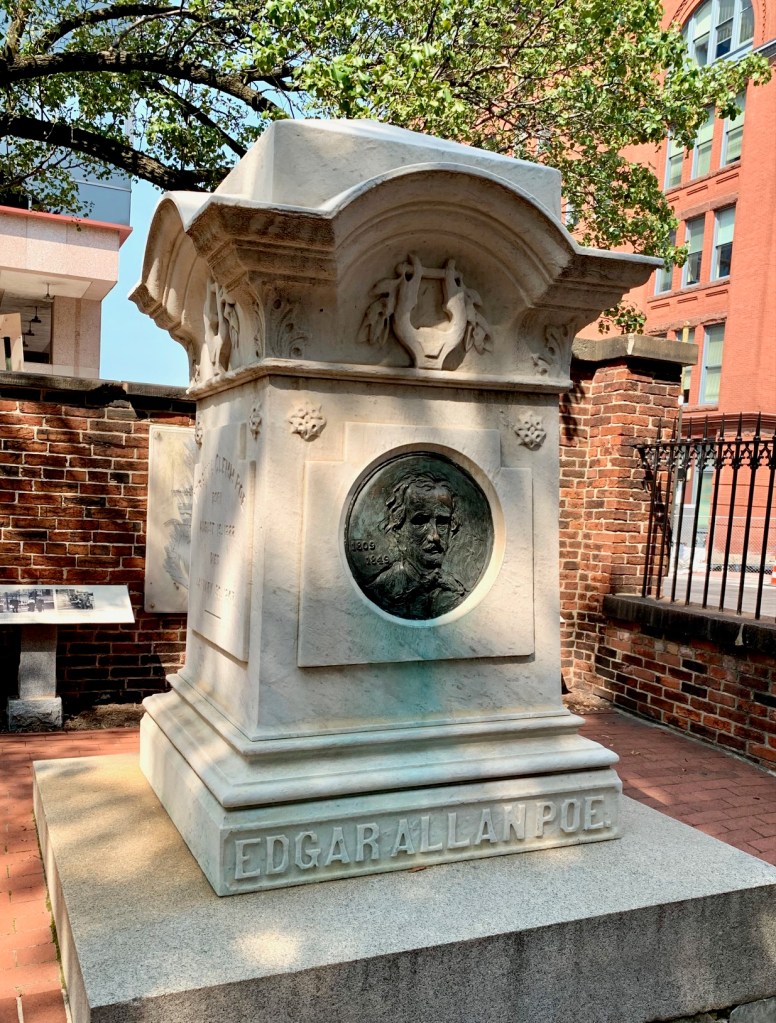
Living in Baltimore, one cannot help but fall into a nostalgia for its salient successes over the many years. I’ve watched “The Wire,” of course, and we once dined next to David Simon in DC (I successfully suppressed my desire to fanboy him). I grew up quoting “Diner” by Barry Levinson and also saw his “Tin Men,” both of which celebrated the city’s golden years. I have visited the gravesite of Edgar Allan Poe and lived to tell about it. There was always something cool and outlandish about the 1970’s Baltimore Colts with QB Burt Jones (a friend once quoted to me that his passes were like a “frozen rope”) and coach Ted Marchibroda. We used to go to Orioles games at the old Memorial Stadium (I once caught a foul ball on ricochet and gave it to a kid whose pleading face would have imploded the Eye of Sauron) that was built more for baseball anyway. I forced myself to watch John Waters’ cult-film “Pink Flamingos” (1972) and that winking butthole is indelibly etched in my cultural memory. More recently I read an anthology of articles written by HL Mencken and was utterly amazed by his writing skill and how his sociopolitical analysis, some of which has been reproduced on this blog, is still relevant today. And several years ago, we toured Ogden Nash’s old house at 4300 Rugby Road, where he did most of his writing. It had fallen into disrepair and was for sale (well out of our price range) but had retained a ghostly essence of grandeur and refinement. As is no doubt true for many, my first introduction to poetry was through light verse of Dr. Seuss, A.A. Milne, and Ogden Nash. My parents had the five-volume set of his work, and I was immediately drawn to his playful puns and funny neologisms. My favorites were his animal poems (“God in his wisdom made the fly / And then forgot to tell us why”). I prefered (and still prefer) short poems, ideally funny but also with a heart. And while some offhandedly categorize Nash’s work as cheap doggerel, in reading an anthology of his work I discovered a remarkable range of poems in length, subject matter, style, degree of introspection and often with an endearing wisdom that sustains him in my personal pantheon. I will reproduce some of my favorites here. Enjoy!

Here’s a good rule of thumb:
Too clever is dumb.

— ogden nash’s “reflection on ingenuity”
4300 Rugby Road in Baltimore, MD

“This one is entering her teens,
Ripe for sentimental scenes,
Has picked a gangling unripe male,
Sees herself in bridal veil,
Presses lips and tosses head,
Declares she’s not too young to wed.
Informs you pertly you forget
Romeo and Juliet.
Do not argue , do not shout;
Remind her how that one turned out.”

— ogden nash on one of his daughters in “The romantic age”
Divine is a force to be reckoned with in “Pink Flamingos” and is gloriously gunning at traditional gender roles.

“To keep your marriage brimming,
With love in the loving cup,
Whenever you’re wrong admit it;
Whenever you’re right, shut up.”

— ogden nash’s “a word to husbands”
Baltimore circa 1960

“Here men walk alone
For most of their lives,
What with hydrants for dogs,
And windows for wives.”

— ogden nash’s “The City”
Baltimore’s Memorial Stadium. I always found it disorienting when a football field was overlaid atop a baseball diamond. That had to also confuse the players. In a way, it’s a fitting metaphor for Baltimore in never quite fitting (but also in never quite quitting).
In 1968, Nash paid homage to his beloved Baltimore Colts in the pages of LIFE magazine, inspired by the play of their third-string QB, Tom “Garbage Can” Matte. The coach of that team? Don Shula.

“Is there a Baltimore Colts fan alive
Who’s forgotten Tom Matte in ’65?
The Colts by crippling injuries vexed,
Unitas first and Cuozzo next —
What would become of the pass attack?
Then Matte stepped in at quarterback.
He beat the Rams in a great display,
He did — and he damn near beat Green Bay.
Ask him today to plunge or block,
Tom’s the man who can roll or rock.
In Tokyo, they say karate.
In Baltimore, they call it Matte.”

— ogden nash in life magazine dec 1968

“Enter, breath;
Breath, slip out;
Blood, be channeled,
And wind about.
O, blessed breath and blood which strive
To keep this body of mine alive!
O gallant breath and blood
Which choose
To wage the battle
They must lose!”

— ogden nash’s “untitled”
Bubbles, a favorite character from “The Wire”

“London Bridge is falling down —
But stocks are going up!
Hunger shuffles through the town —
But stocks are going up!
Tell the farmer in the dell,
Tell the striker in the cell,
Zero hour and all is well —
Stocks are going up!..”

— fragment from Ogden nash’s “Don’t sell america short”
“Diner” (1982) is a great connector in the game “Six Degrees of Kevin Bacon” since you get (left to right) Tim Daly, Mickey Rourke, Daniel Stern, Kevin Bacon, Steve Guttenberg, and Paul Reiser, as well as Ellen Barkin. “Cornell, you BOZO!” These dudes could fili-BLUSTER with the best of them.

“Once more the filibuster runs amok,
A kissin’ cousin of the jabberwock.
And what might be this fabulous filibuster?
A beast composed of blathering and bluster.
Yet when it whiffles to the Senate floor
Brave statesmen quiver at its windy roar.
Reason and decency cry out in vain,
And human rights go swirling down the drain.
Though some set forth to slay the filibuster,
It stages more and better last stands than Custer.”

— Ogden nash’s “the filibuster”

“When you look life in the face
There’s too much time, there’s too much space,
There’s too much future, too much past,
Man is so little, and the world is so vast;
You may fancy yourself as an immortal creature
But you’re just a cartoon between a double feature…”

–fragment from the song “Round about” by ogden nash for the 1946 musical “sweet bye and bye”
Mt Olivet Cemetery in Baltimore, MD

“Time walks on and people die;
Other people, never I.”

— ogden nash’s “unititled”