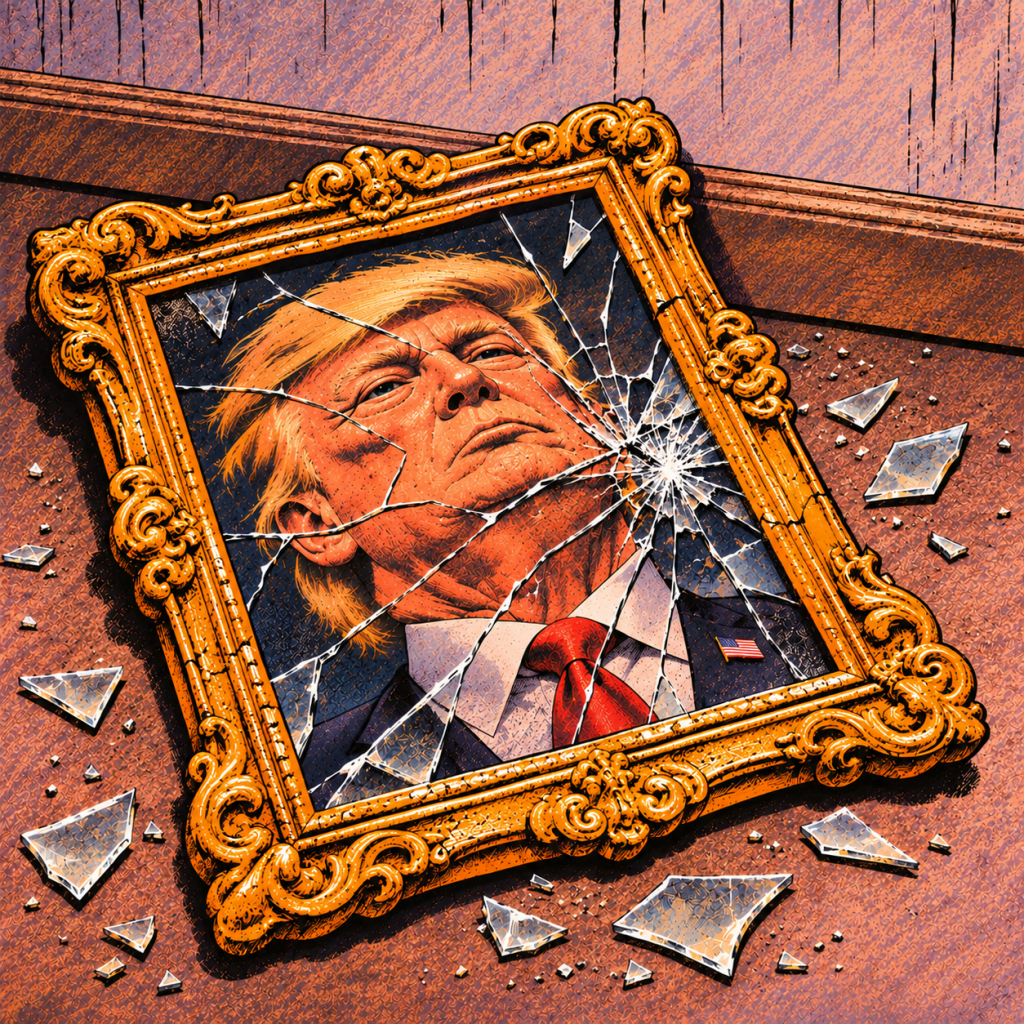
Suffice to say I am perfectly ambivalent about artifical intelligence, as I think many are. The arguments are well known. It has potential to solve monumental problems in health care while improving efficiencies across society through rapid and complex mathematics/computing. True enough. On the downside, in the extreme, it could annihilate all humanity. Oh, well. And between those two poles of blissful utopia and blood-soaked armageddon is where the tire kisses the road. Improving workplace efficiency. Loss of jobs. Fostering creativity. Theft of intellectual property. Rapid access to deep knowledge and information. Identity theft and the draining of our bank accounts. The list goes on and on. My view is stilll evolving but I remain guarded about its use. A.I. certainly needs strong human guidance and oversight, IMO.
Today, I am focusing on A.I.’s use for creative endeavors. It has injected a boost of energy into my own mini-projects, magnifying my enjoyment, such as the fake album covers and cartoons on this blog. It simply allows me to more fully and visually realize an idea or joke. Things I could not hope to do myself. And, crucially (for me), these are tasks that I have no plan to do professionally or for monetary gain. That is, I don’t feel as though I’m taking anyone’s job away. Where I have avoided its use is in areas that I try earnestly to create original material, such as songwriting and poetry. Not that these are for sale, but I fear the slippery slope when software can crank out a pop song in mere seconds. I know it is “stealing” riffs and creative modes from other artists, which renders the “new” work tainted and ultimately unoriginal. Derivative. Not truly mine. That feels like a lie. Or only half an accomplishment.
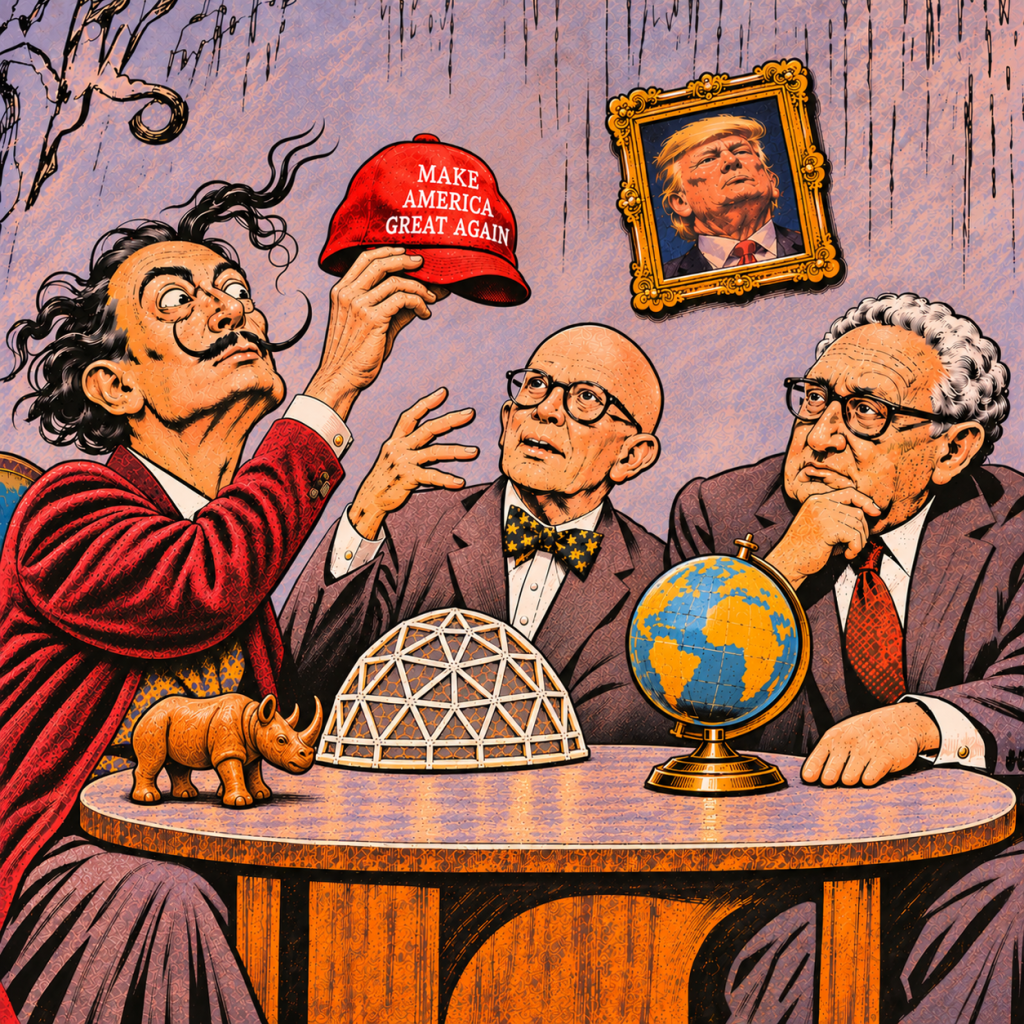
Now, I am not an aspiring playwrite. Not yet anyway (given 200 more years of life, however…). But then I had this flash idea to test the capabilities of A.I. (slippery slope warning!), and so prompted ChatGPT to write a short, two-act play on the subject of MAGA that was to be a conversation among Salvador Dali, R. Buckminster Fuller, and Henry Kissinger. This, itself, is a concept I borrowed from Tom Stoppard’s “Travesties” that depicted a fictional discourse between Vladimir Lenin, James Joyce, and Tristan Tzara. One irony of A.I. is that this sort of creative borrowing, Harold Bloom’s “anxiety of influence,” is all too human — just not in the everything everywhere all at once style of ChatGPT. I did some light editing, such as removing the melting clock that it had on the table. Too on the nose. At mid-century, Dali had an obsession with rhinoceros horns that was anachronistically and hilariously referenced in the 1920’s of Woody Allen’s “Midnight in Paris.” In the context of our play, this imagery might invoke Ionesco’s incredible anti-fascist play “Rhinoceros.” Or else that infamous reference Trump consistently makes of GOP members who thwart him (RINO = Republican In Name Only).
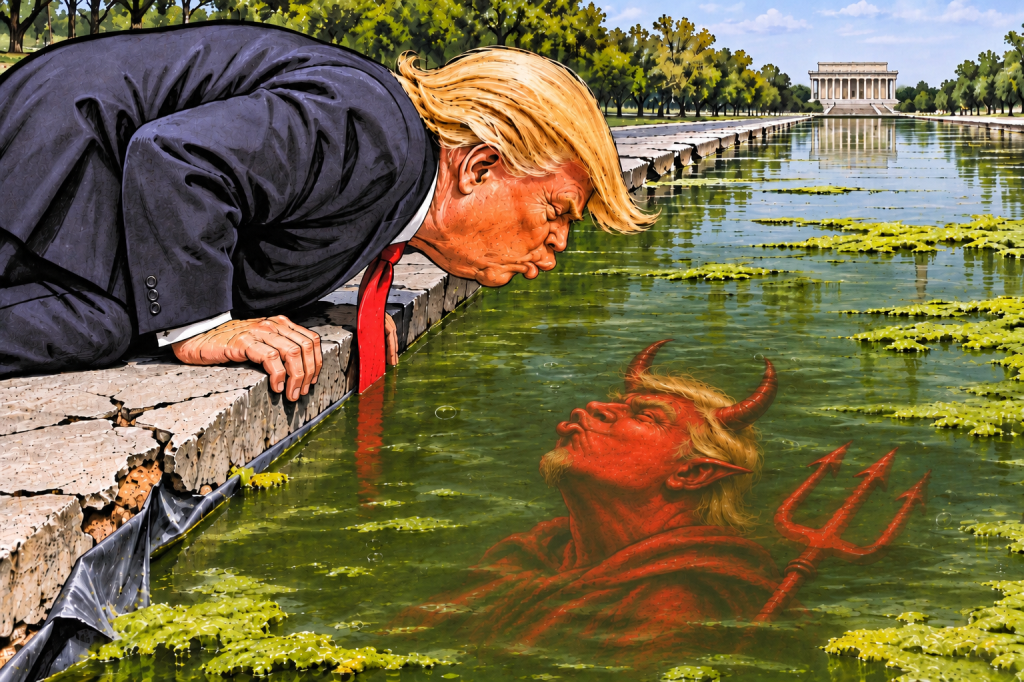
One credo to live by in the post-post-modern era: if you’re using A.I., you still have to make it your own! I added a nod to Ionesco’s running joke, satirizing racism, about Asian vs African rhinoceros. The humerous back-and-forth in the play was whether the observed rhinoceros had one (in real life, Asian) or two horns (African). How clever I am! I then inserted Trump’s verbal taunt at the end (the clapping was Chat’s idea). And I also prompted a few cartoon images to support the dialogue. The result is, I’ll dare say, interesting. But you can be the judge…
“A DEVILISH DANCE”: A Short Play in Two Acts
CHARACTERS:
SALVADOR DALÍ — Surrealist painter. Flamboyant, theatrical, delighted by absurdity,
but offended by bad taste.
R. BUCKMINSTER FULLER — Inventor, futurist, optimist. Believes humanity can
engineer its way out of nearly anything.
HENRY KISSINGER — Diplomat, strategist, cynic. Believes power is the only reliable
currency.
A windowless room. Three chairs surround a small table. On the table sit a red
MAGA hat, a small wooden rhinoceros, a geodesic dome, and a globe.
A portrait of Donald Trump hangs crookedly on the wall.
ACT ONE: THE MOVEMENT
The three men sit staring at the red hat.
DALÍ: Magnificent! An entire political philosophy contained in a cheap red hat!
FULLER: It’s an extraordinarily inefficient use of the human imagination.
KISSINGER: On the contrary. Four words. Millions of adherents. Remarkable political
economy.
DALÍ: But the words mean nothing!
KISSINGER: Salvador, meaning is irrelevant. What matters is whether people believe
them.
FULLER: That’s precisely the problem. MAGA is a backward-looking proposition.
Humanity cannot solve twenty-first-century problems by attempting to reconstruct the
twentieth.
DALÍ: Or the nineteenth! Or the eighteenth! Why stop there? MAPA! Make America Pleistocene
Again!
KISSINGER: Nostalgia is a powerful political instrument.
FULLER: So is electricity. But one should understand what one is plugging into.
DALÍ: I admire the spectacle! The rallies! The costumes! The music! The gilded gold trinkets!
The theatricality is exquisite!
KISSINGER: So you approve?
DALÍ: Absolutely not! Surrealism requires imagination. This is merely reality behaving
badly.
FULLER: I would argue that MAGA represents a fundamental misunderstanding of
systems theory. You cannot isolate one nation from an interconnected planetary
economy.
KISSINGER: Nations are not engineering projects, Bucky. They are collections of
competing interests held together by power.
FULLER: And power without intelligence is simply organized stupidity.
KISSINGER: Intelligence without power is a faculty seminar.
DALÍ: Gentlemen! You are both missing the essential question.
KISSINGER: Which is?
DALÍ: Why is the hat so ugly?
Silence.
FULLER: The typography is certainly uninspired.
KISSINGER: The typography is beside the point.
DALÍ: Henry, with you, everything beautiful is beside the point.
BLACKOUT.
ACT TWO: THE GREATNESS
The portrait of Trump has fallen from the wall. Nobody bothers to pick it up.
KISSINGER: Let us consider the matter objectively. Trump understands something that
intellectuals consistently underestimate: political power is emotional, not rational.
FULLER: That is precisely why civilization requires better education.
DALÍ: No! Civilization requires better dreams!
KISSINGER: Civilization requires order.
FULLER: Order is not the same as progress.
KISSINGER: Progress is not the same as stability.
DALÍ: And stability is not the same as art! Look at that portrait. The man has turned
himself into an ugly monument while still alive!
KISSINGER: Political self-mythologizing is hardly new.
DALÍ: Yes, but usually one waits until death to become a statue!
FULLER: What troubles me is the definition of greatness. We possess the technological
capacity to feed, house, and educate humanity, yet we continue to define national
success in terms of domination.
KISSINGER: Because history is not a humanitarian exercise.
FULLER: History is what happens when humanity fails to exercise its intelligence.
KISSINGER: A charming sentiment. Completely useless at a negotiating table.
DALÍ: I have a proposal! We replace the entire MAGA movement with a giant inflatable
rhinoceros!
KISSINGER: Why?
DALÍ: It is equally loud, equally dangerous when provoked, and considerably more
honest about its intentions!
FULLER: Could the rhinoceros be constructed from recyclable materials?
DALÍ: Naturally!
FULLER: One horn or two?
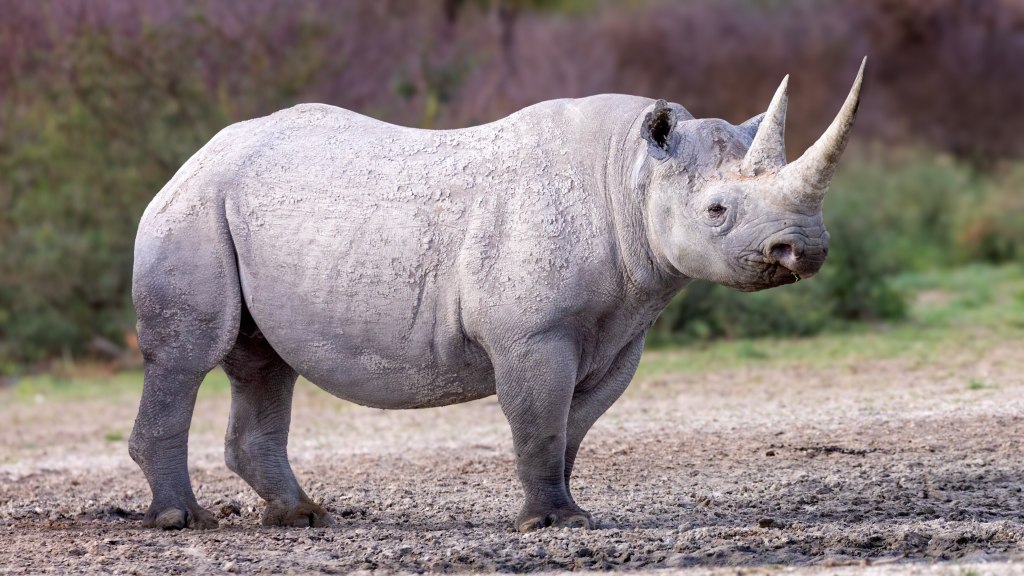
DALÍ: All three!
KISSINGER: You’re both insane.
DALÍ: Henry, you spent your life negotiating with dictators. I merely painted them in my
dreams.
KISSINGER: Dreams don’t change history.
FULLER: Neither does refusing to learn from it.
A pause. Kissinger picks up the red hat and examines it.
KISSINGER: You must admit, the slogan is effective.
FULLER: But it contains no measurable objective. What constitutes greatness? For
whom? At what cost?
DALÍ: And when was America great? Tuesday? August 1945? Before the invention of
polyester?
KISSINGER: You’re overthinking it.
FULLER: That’s what people say when they prefer not to think
Dalí grabs the hat and places it on the globe.
DALÍ: BEHOLD! The world wearing its own stupidity!
KISSINGER: Take that off.
DALÍ: Why?
KISSINGER: It looks ridiculous.
DALÍ: At last, Henry! An aesthetic judgment!
The geodesic dome begins to glow.
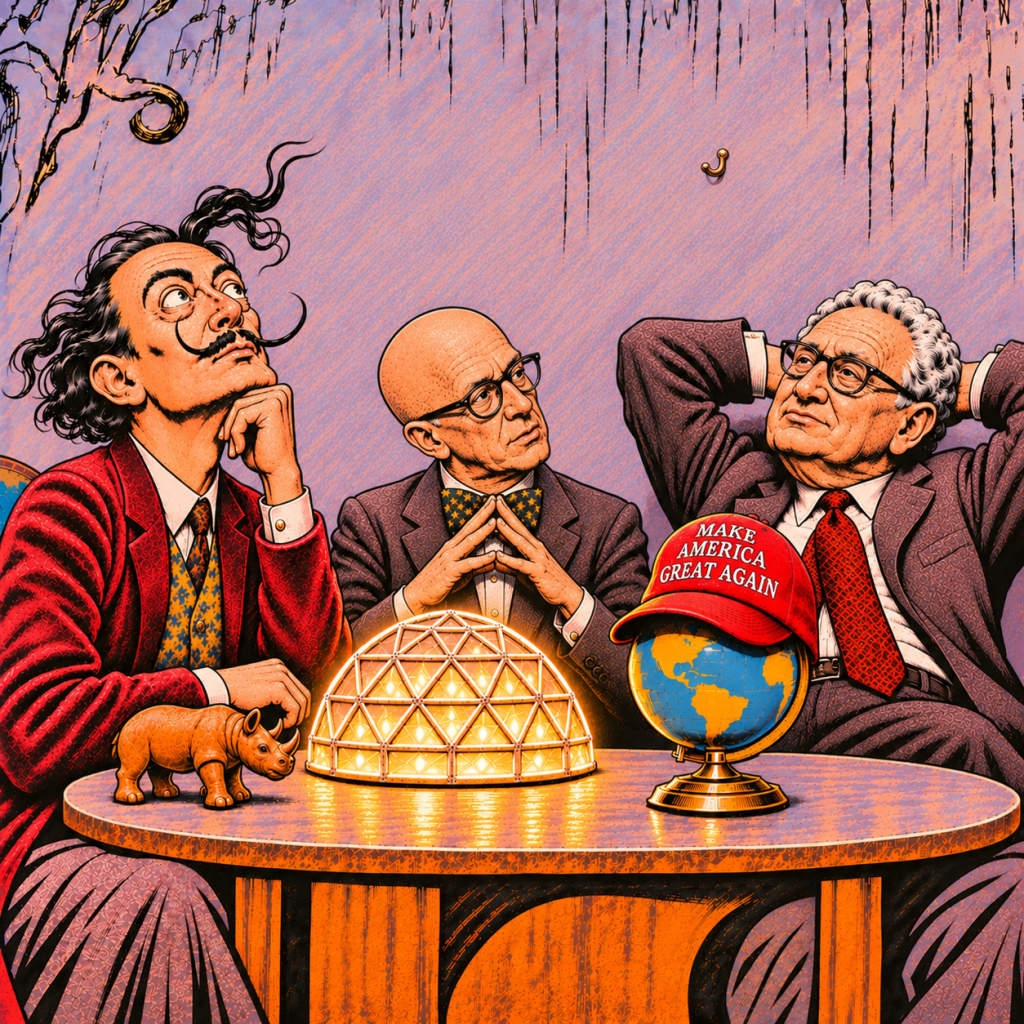
FULLER: Gentlemen, perhaps the real question is not how to make America great again,
but how to make humanity viable for the first time.
KISSINGER: That will never fit on a hat.
DALÍ: I have it!
He snatches the MAGA hat, turns it inside out, and places it on Kissinger’s head.
DALÍ: MAKE ABSURDITY GREAT AGAIN!
KISSINGER: Get this ridiculous thing off my head!
FULLER: Actually, Henry, it suits you.
The portrait of Trump begins to slowly and mockingly applaud while taunting, “You are all three low-IQ losers. You’re fired!”
All three stare at it.
KISSINGER: Who authorized that?
DALÍ: Nobody, Henry.
A pause.
DALÍ: That’s democracy!!
BLACKOUT.