You could start a bar fight over A.I.’s many pros and cons. I’m picturing pocket protectors and bottles of ZIMA flying around the room! Mine is a perpetual state of fluctuating ambivalence. I will stipulate that in my medical career as a radiologist, I embrace it as an adjunctive tool (notions of our replacement being wildly overblown, IMO). And the benefits are clearly there as regards heavy-lifting mathematical computations, which no doubt will lead to many important scientific and medical discoveries going forward. Similarly, much of the accounting and HR busywork can easily be offloaded, while anxiously noting the adverse impact it will have on many job holders. Ultimately, however, A.I. is here to stay and we’d better get used to it while also fortifying our safety and privacy with strong regulations — surveillance drones and cyber-policing ICE agents no longer being the stuff of pure science-fiction.
But today I want to confine the discussion to our creative endeavors. To me, the question boils down to how much of my unique self am I willing to relinquish for the sake of outsourced efficiency or novel ideas. And if a poem or song lacks my fingerprints, is it really mine? How will I know whether Chat-GPT hasn’t clandestinely ripped off someone else’s work? I feel the pull of the old-fashioned here. AS cliche as it sounds, the process is the actual thing, not the end result. It’s more about the difficult climb than the view from the summit. As such, I’ve been thinking of analogies, imperfect as they may be, that might shed light on the neurocognitive effects of A.I. on this creative process:
Is A.I. like a GLP-1 short-cut for the brain? If you don’t write the draft proposal yourself and then repeatedly revise it, how well do you understand its nuances and problem areas? How well can you defend it?
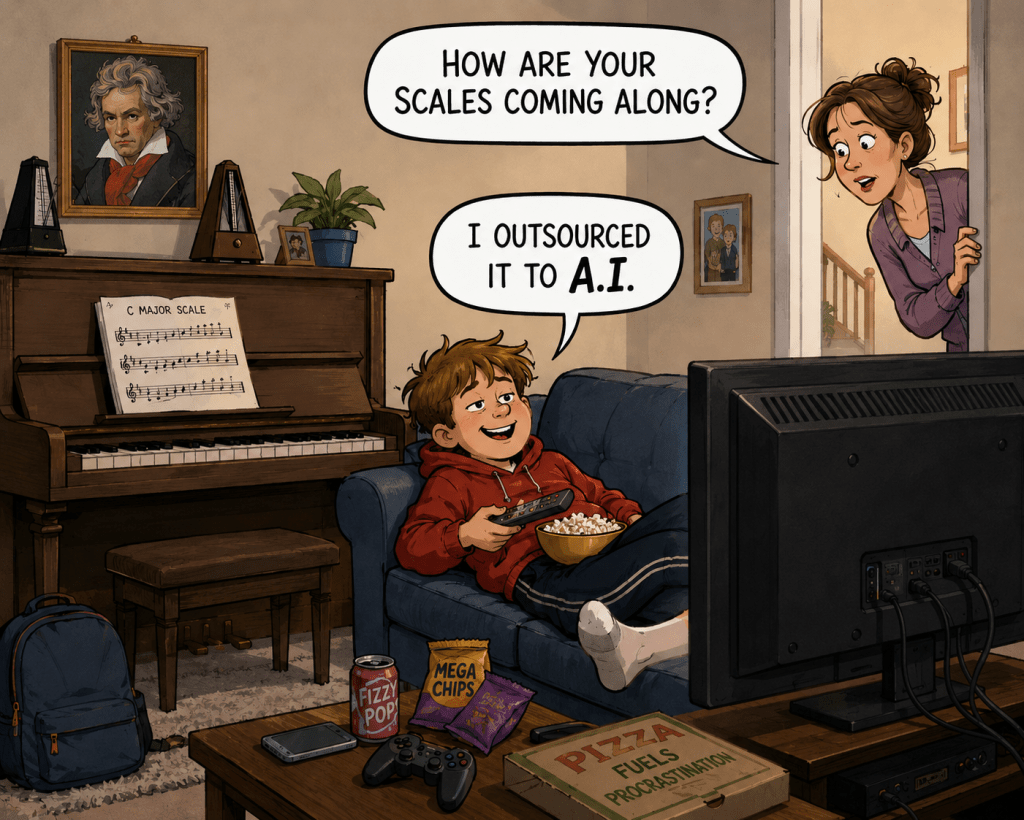
Is A.I. like outsourcing the important muscle memory work of doing musical scales on piano or guitar? When it comes time to improvise a solo, won’t your performance suffer?
In the sports arena, which clearly has a creative element, is A.I. an equivalent of having someone do your free-throw drills for you? Is it absolving you of the hours of practicing short putts? If so, isn’t it obvious that there are adverse downstream effects on your performance, especially under pressure?
If A.I. can, say, create your paint colors for you, have you not lost something important in that mundane and tedious process of mixing your own pigments and developing your individual colour (see, I went full-Euro on your ass!) palette? This trial-and-error process, with its inherent surprise discoveries and disappointments, that pays dividends in an earned intuition may be too valuable to cede.
One way to approach this is to think in terms of what are essential building-block skills versus things that we can offload without erasing our thumbprints. As an example, I wrote a silly song recently and have asked Chat-GPT to block out a scene sequence for an accompanying cartoon video (watch this space!). Now, that’s a skill I don’t have and likely will never have, so there’s no loss there. Same is true for our recent spate of COVFEFE album covers. Joyfully fun and cathartic, to be sure, but also something I wouldn’t have the capacity to do alone. So, a net gain plus the added bonus of collaboration with my buddy, Agent 99-X. However, in contrast stands my reluctance to give over to A.I. the writing of song lyrics (or this blog) to an artificial source. And while I am reluctant to speak in absolutes, the very heart of any creative endeavor should be considered near sacrosanct.
Allow me to elaborate on that equivocation using a musical analogy. Tom Waits, whom I relish as an artist, sometimes uses an affected vocal style and even mechanically alters his voice using a megaphone. I would call that am embellishment. An accent. Spice and seasoning. Why? Because the song and his vocals would stand alone without it. It’s a minor departure for him in a career filled with wonderful fugues and departures. And, similarly, when other talented acts like The Strokes or LCD Soundsystem use vocal effects, it isn’t to mask imperfection but rather to create a transient effect or vibe. I’m totally cool with that and might someday experiment with it myself. But the fundamentals, the very foundation of the songs, remain rock solid. A test: would the work stand alone without the A.I.-assist? I think, in the end, it’s up to each artist to set limits on how much of their process they are willing to relinquish while maintaining pride in their own creative process. And we all know that commercial success is an absolutely terrible measure of artistic merit. How else could one explain the career of James Blunt or Nicolas Cage or Jeff Koons??
I’ll end it with a quote from Australian musician Nick Cave who declares that A.I. is “bad for good songwriters, good for bad songwriters.” And which would you rather be?

