“The klan (KKK) is not a club for snobs, it is a device for organizing inferiorities into a mystical superiority; its primary aim is to turn jackrabbits, by amalgamation, into lions. This business, of course, makes for absurdity.”
— H.L. Mencken in The Baltimore evening Sun from august 1925

“The klan put it all over its enemies this afternoon. The parade was grander and gaudier, and by far, than anything the wizards had prophesized. It was longer, it was thicker, it was higher in tone. I stood in front of the Treasury for two hours watching the legions pass.” — H.L. Mencken (from same article as above in Aug 1925)
I suspect I am not alone in my enjoyment of unexpected convergences. So dig this one. I recently began reading a compilation of articles written by the infamous Baltimore journalist H.L Mencken. Many were written 90-100 years ago but still read as relevant today, because there really is “nothing new under the sun” in the course of human affairs. I found his article on a KKK parade in Washington, DC from August 1925 particularly insightful, since you could easily substitute the Proud Boys and Oath Keepers and other denizens of the ragtag MAGA-verse for their white-hooded fellow travelers. Like a boil on our collective national ass-crack is this mutating psychological sepsis. I hereby propose a new version of the famous motto — in celebration of the incarceration of many Jan 6 insurrectionists, one day to hopefully include DJT — sic semper tyrannis now modified to sic semper big-anus, which would translate roughly to “thus always to total assholes.” As it happens, I had the luck to attend a fine exhibition of Phillip Guston at the East Wing of the National Gallery of Art last month. This collection gives a good sense of the breadth and arc of his artistic output. Highly recommended (in DC through August 27, 2023). What I’ve captured on this blog are some of his works dealing with human conflict. They are colored by his personal experience and also observations about fascism, the Holocaust, the Vietnam War and the political violence of the KKK. I have interwoven quotes from Mencken with the works by Guston to underscore the universality and continued importance of their observations.
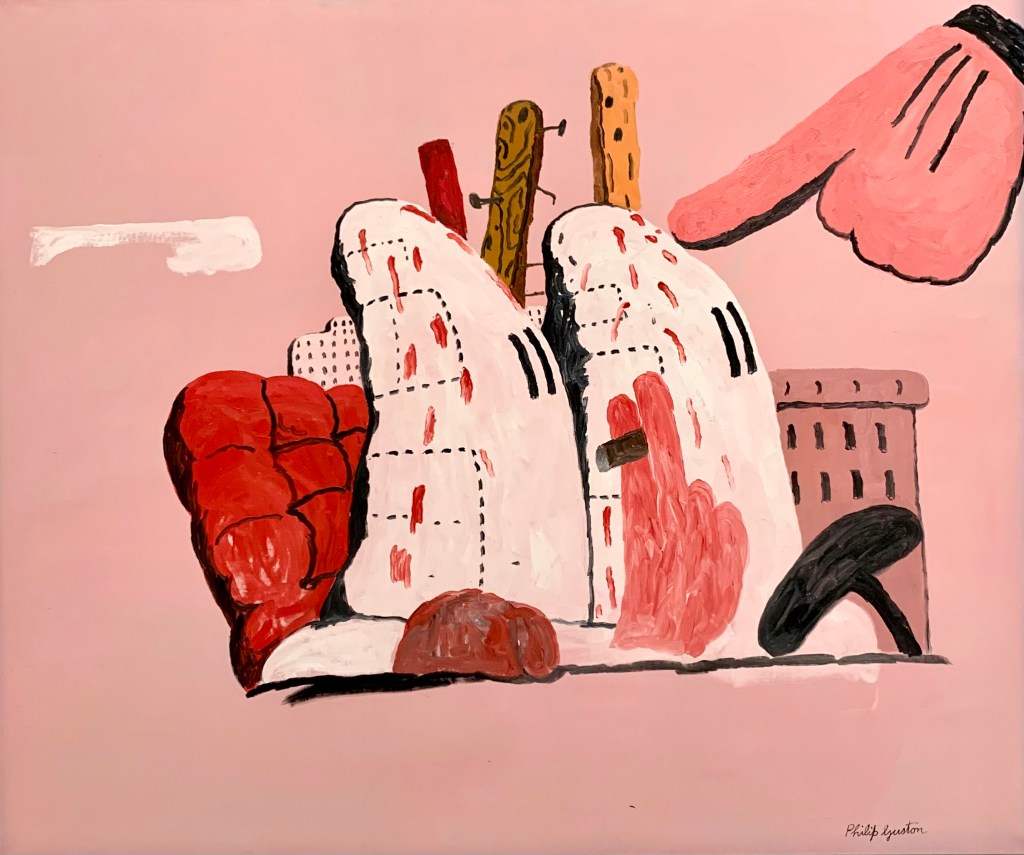
“It is a tragedy of this great Republic, perhaps, that whenever its patriots get together they look like a gang of meat-cutters and curve greasers on a holiday. So, today, if the truth must get out. Until I gave up, I saw perhaps 10,000 march by. There was not, so far as I could observe, an intelligent face or a comely one on a woman. They were a common folk, and their commonness radiated from them like heat from a stove.” — H.L. Mencken (Aug 1925)
So what did I learn? Please allow me to enumerate the salient aspects:
1. Philip Guston (1913-1980) was a Canadian born American artist. His parents were Jewish and had immigrated from Odessa (Ukraine) to Montreal to escape persecution. They moved to LA in 1922. There they became aware of KKK aggression against Jews and Blacks, a theme he would address repeatedly in his work.
2. In 1923, his father hung himself in their shed and a ten year old Philip found his father’s body. The rope became one of his recurring motifs. Another frequent image is that of dismembered legs where they stand-in for the victims of political violence across history. But it is also noted that the young Guston tragically lost his brother to gangrene of the legs after they were crushed between two cars.
3. Guston took an early interest in drawing and his mother enrolled him in a correspondence course with the Cleveland School of Cartooning. The twin-edged sword that is the nature of cartoons would continue to influence his style throughout his career.

“Here are the makings of every imbecility, from fundamentalism up. If these poor blockheads are gullible enough to pay $10 apiece for nightgowns worth perhaps 50 cents, then they are gullible enough to swallow any conceivable nonsense.” — H. L. Mencken (Aug 1925)
4. In 1927, Guston enrolled in the Manual Arts School in LA where he met fellow classmate Jackson Pollock. They would later both leave their mark on the New York School as so-called “abstract expressionists,” a term that Guston, however, did not embrace.
5. In the 1930’s, Guston did mostly mural work commissioned by the WPA, under FDR’s New Deal, and many had political themes dealing with violence, war, terrorism and fascism. One of his murals, an anti-Klan statement, was shot up by local police in Los Angeles. A reminder of the comingling of state power and racism that still rings true across this country.
6. In 1937, he exhibits “Bombardment,” a response to the fascist aggression in Spain and associated German bombing raids.

7. In the 1940’s and 50’s, Guston veers and makes use of the emerging vogue for emotive color abstraction, joining other artists like Rothko, Pollock and de Kooning. He became commercially successful at that time and was embraced by the art world. However, he later rebelled against abstraction saying, “American abstract art is a lie, a sham, a cover-up for a poverty of spirit… it is an escape — from the true feelings we have — the ‘raw’ — the primitive feelings about the world — and us in it, in America.”

8. In the 1960’s and 70’s, his works return to a figurative style. In 1970, he has a solo exhibition at the Marlborough Gallery in NYC where he declared that he was no longer an abstract painter and that he wanted to tell stories. His 30-odd canvases revealed a new cartoony style, which was largely rejected by his peers and the critics. He stated that his true subject was “freedom” and hewed only to his own gut feelings and convictions. Klansman feature prominently in this period, connecting his own early experiences in LA with the 1960’s push for civil rights and the inevitable reactionary backlash by racist elements within the white majority — something ever-present but burgeoning in periods of rapid social reform in the 1870’s, the 1920’s and the 1950’s-60’s. What is clear, however, is that there is no single reading of these figures. Yes, they represent a truly malignant and violent force in our culture, one that he experienced first hand. But they are also sad and pathetic characters filled with irrational fear that is undergirded by ignorance. Donald Trump’s malign influence comes cloaked in a bumbling yet strangely effective buffoonery — he gets away with things because people don’t take him seriously. And the reductive power of the political cartoon serves as an analogous device for these works. Why would one need a hood if their cause was just, it seems to ask. And why does a hooded man do a self-portrait that way unless that is who he really is, an empty hood. Yet Guston’s own words take it further still, introspectively. “They are self-portraits,” he stated. “I perceive myself as being behind the hood.” That we are all complicit in some way. And time has a way of rewarding enigmatic works, their meaning continuously evolving with us (see also Shakespeare, Beckett, and de Chirico).

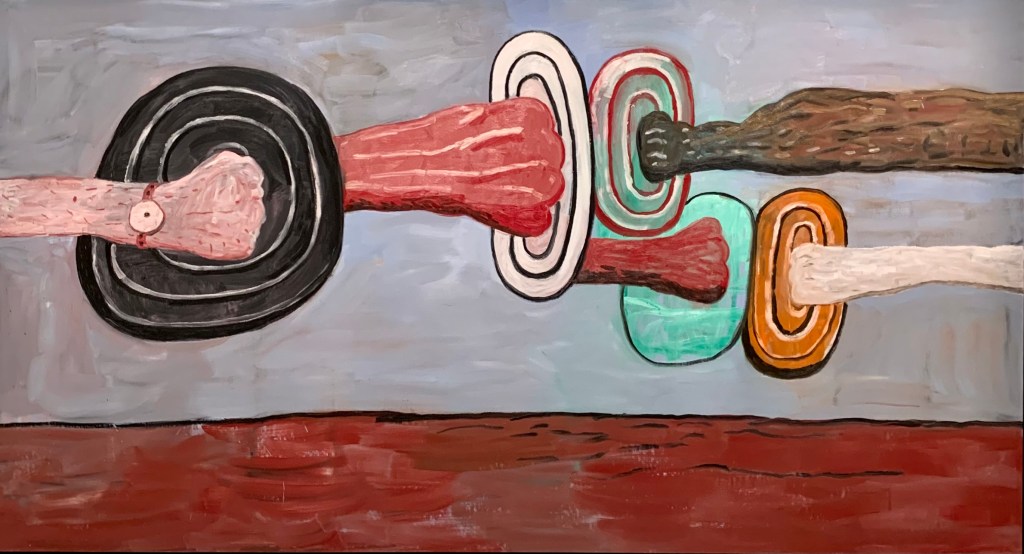
“But such foolishness, in all probability, is inseparable from patriotic emotion. What is believed at the lowest levels is, after all, not much more ridiculous than what is believed at the highest. Patriotism is not scientific; it is romantic. The essential question is not whether it is sound in logic, but whether it is genuine in feeling. The ku kluxers, this afternoon, sweated their way into respect.” — H. L. Mencken (Aug 1925)
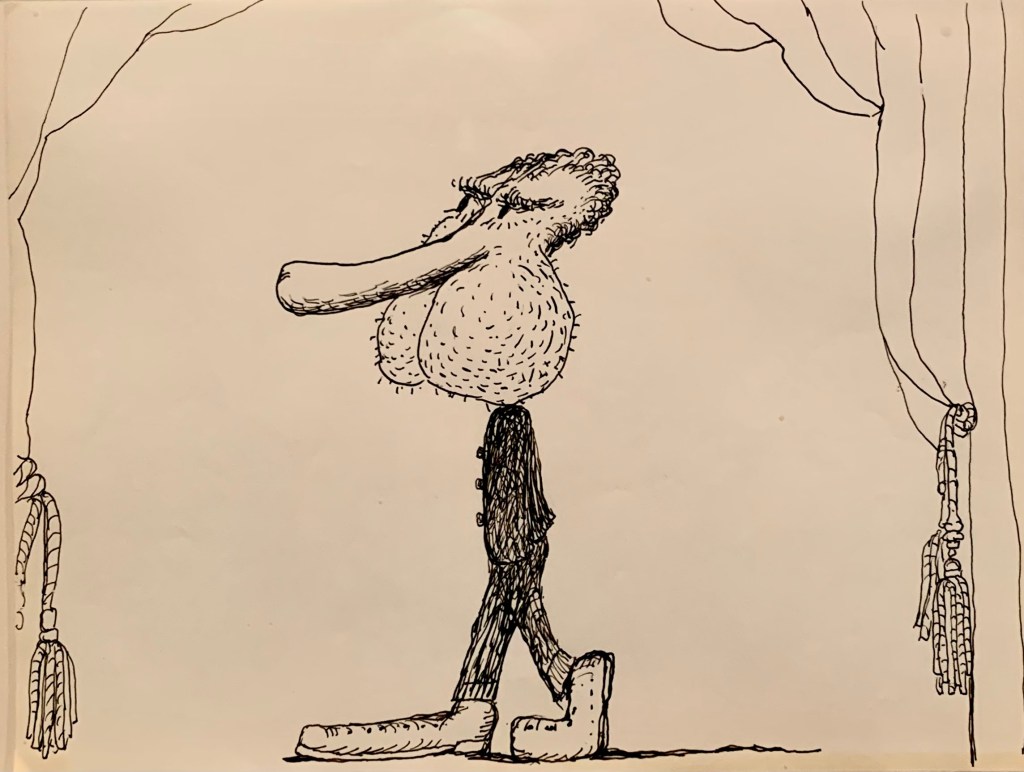
9. In 1971, inspired by Philip Roth’s swerve into satire, Guston embarks on a manic spree of over 200 ink drawings on the life and times (and later crimes) of Richard Nixon that he complies into book form called Poor Richard. These were eventually exhibited posthumously in 2001. The East Wing of the National Gallery of Art is now running a concurrent exhibit of his Nixon cartoons in a separate gallery.
10. The limbs pile high in Guston’s world. The booted legs represent those of his brother, the victims of KKK violence, the consequence of the civil war in Spain, WWII and the jackbooted soldiers of the Nazi regime, the genocide of the Holocaust, and the tragic losses of the misguided Vietnam War. Although he died in 1980, these stacked limbs could also, by extension, reference the victims of Oklahoma City bombing in 1995, the devastation of 9/11, the destruction unleashed in the Iraq war, the ever-increasing toll of mass-shootings in the US, or the war in the Ukraine. These legs, I think he’s saying, are us. That we all bear some of the blame.


“That these poor folk are exploited by rogues is an unpleasant detail, but certainly nothing new in the world. It is the penalty of their ignorance, at all times and everywhere… They have been marching in idiotic parades, whooping gloriously for charlatans since the dawn of history and they will go on doing it forevermore. Today’s procession was probably one of the most creditable that they can boast of. It was earnest and it had a certain modest dignity. If they go back to their forlorn villages and their drab homes behind the gas works believing that they have achieved something they will not be far wrong.” — H. L. Mencken (Aug 1925)
Finally, what strikes me about both Mencken and Guston, in this fortuitous collision, is that they were both brutally honest in their observations. Yet they also managed to leaven with a tincture of humor and with a certain sympathy (if not empathy) for these misguided Klansmen, while unsparing of their manipulative leaders. If we can see a small piece of ourselves in them, as in the case of the MAGA horde, then perhaps we have a chance of healing our weeping national dehiscence.


 Great Exudations
Fantastic Steve…thanks man
>
LikeLike