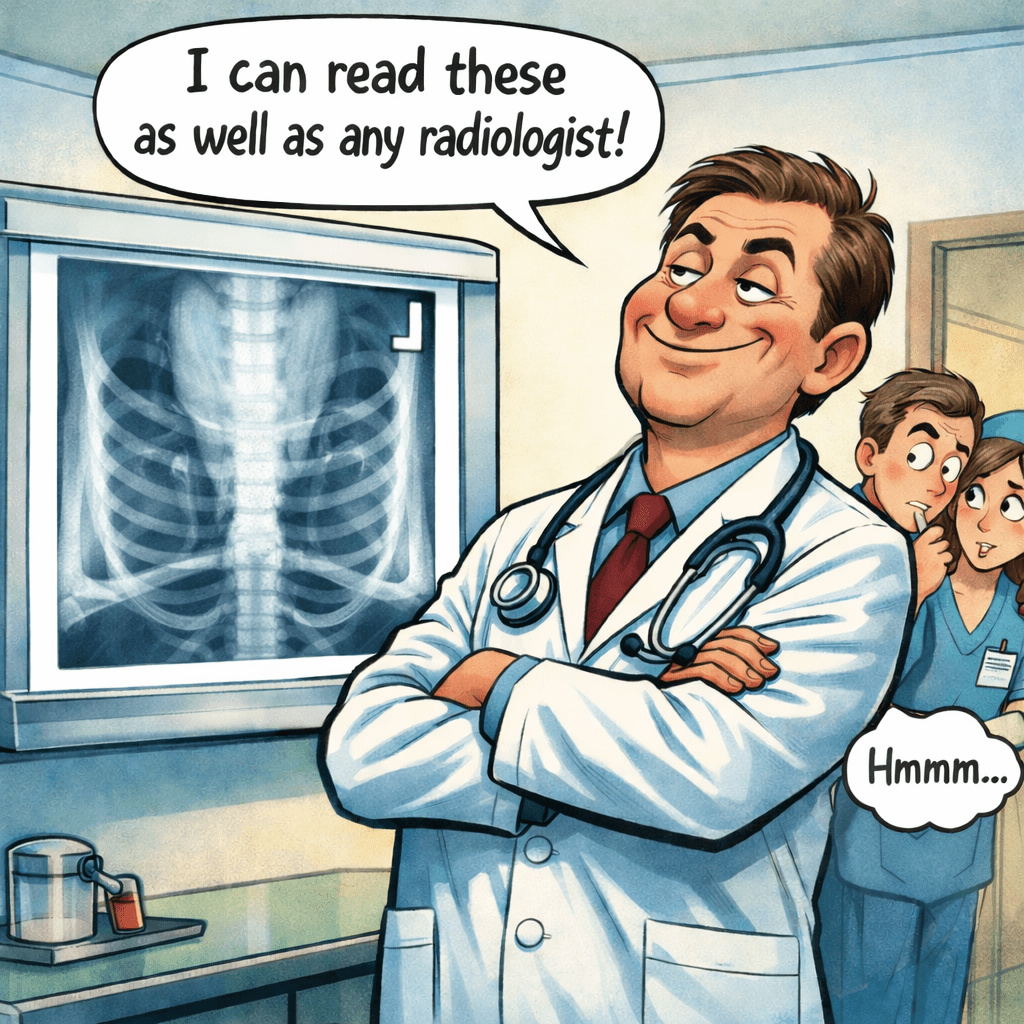
Let me start by saying that in my 30+ year career in radiology I have met a few clinicians who were truly excellent in the interpretation of imaging. But these people I could count on one hand, exceptions that prove the rule, and that statement comes with several important caveats:
#1: They acquired said knowledge with a great deal of help from the radiologists with whom they worked over the years, something I don’t recall them ever acknowledging (just like A.I.!!). To observe them, one might come to the erroneous conclusion they were just born with it. But I will admit that an observant and experienced clinician can surpass a general radiologist within their very specific area of practice. Smart people are smart.
#2: Even stipulating the talents of these few outliers, it naturally follows that their skills are not in the least bit generalizable or transferable to others in their clinical realm. That is, one cannot point to the talented critical care provider, Dr. X, and logically conclude that all pulmonologists are excellent at interpreting imaging studies. Yet specious notions like this are commonplace in the hospital. Our residents and fellows run circles around most of them on a daily basis. But as wiser men say, “you don’t know what you don’t know.”
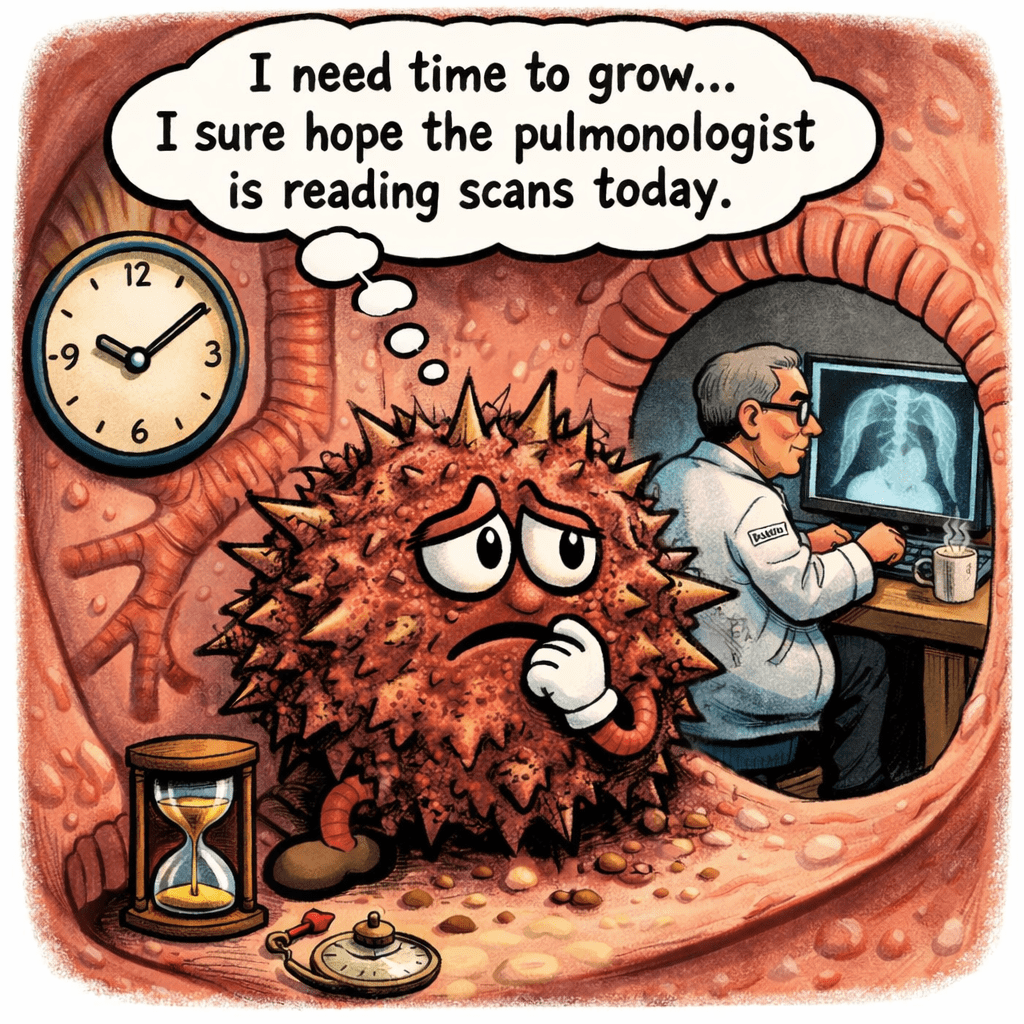
#3: These were subspecialists, including a vascular neurosurgeon and a pulmonologist, whose imaging knowledge was very much confined to their area of interest. If you asked the pulmonologist to make comment about a spine lesion or something in the upper abdomen or lower neck — areas included on all cross-sectional chest imaging — he would have been utterly flummoxed. The same goes for the vascular neurosurgeon trying to interpret an abnormality in the nearby temporal bone or orbit. He had no shot at all. The surgeon in mind once called the reading room angrily demanding to know why the “mass” in the lower thoracic spine wasn’t highlighted in an MRI report. To that our response was, “do you mean the thickened ligamentum flavum that we see pretty much very day?” These types of overcalls are quite common, even from experienced clinicians playing arm-chair radiologist. But there is something in their mental make-up that allows them to subtract out all these overcalls (and the under-calls on images they looked at before getting the final report). Not sure if it’s ego or cognitive dissonance. Maybe a combination. On the wards, and in their own mind, they are as good as any radiologist. On the witness stand, they will rush to say “I am not a radiologist!” They have the luxury of swimming in our expertise. Such that while reading the radiology report and looking at images (especially with our annotated arrows) can satisfyingly say to themselves, “I can see it, too!”
#4: One vitally important thing is that diseases don’t respect the artificial boundaries of subspecialized medicine. Sarcoidosis doesn’t know to stay within the confines of the chest and can also involve the bone marrow, the liver/spleen, the kidneys, any and all lymph nodes, the brain and dura and leptomeninges, the spinal cord and cauda equina, the orbits, even the great toe. Pretty much any structure you can think of. What’s a poor pulmonologist to do? Atop that, patients often have more than one disease. “Fleas and ticks” one of my attendings used to say. The gastroenterologist would have to be nimble enough in interpreting an abdominal CT to spot a transitional cell carcinoma of the bladder or lung cancer in one of the lower lobes. It’s hard to accurately convey just how utterly ridiculous that proposition is. It would be “Keystone Kops” medicine-style. You’d be far better off with A.I. — and that isn’t saying much. But that didn’t prevent my co-chief resident, who was back then defending his decision to go into interventional radiology, from declaiming in the mid 1990’s that diagnostic radiology would be summarily carved up and ceded to the various medical subspecialties. He was hopelessly wrong, of course, as I argued at the time. But, then again, his judgment is so consistently good that he also voted for Trump in 2016 before almost immediately walking the decision back. What is he doing now? He’s a major hospital CEO, thereby proving that to be in the C-suite in medicine you have to be just dull and obtuse enough to be non-threatening to any would-be rivals, learn to read a spreadsheet, and just let the sick keep getting sick. It’s a sort of genius, if you think about it. Looking back, he wasn’t in any way an outstanding clinician, teacher or researcher. His true genius was for politics and self-promotion and probably should be in the Senate sitting next to Ted Cruz and the rest of America’s best talent.
#5: We know from conversations with friends and family members that some clinicians actually pretend that they themselves have interpreted their imaging studies: “I have viewed your images and determined…” Yeah, right. That’s taking credit for another’s work. And it’s one of the reasons why many patients think that a radiologist = radiology technologist.
#6: Clinicians sometimes make a finding that was missed by a radiologist. It happens. Blind squirrels occasionally find acorns in snow, the old expression goes. However, in my experience, they were almost always armed with some key information that gave them a huge leg-up. It doesn’t point to a greater skill in imaging interpretation, it’s a matter of “pre-test probability” or knowing where to look. Highly specific clinical information like a Wallenberg syndrome would allow a neurologist to pick up a very subtle lateral medullary infarct on MRI (like magic!) that could be overlooked without that clinical data. Likewise someone armed with an outside CTA report would have a major advantage in reviewing a brain MRI and then “amazingly” discover a subtle vascular abnormality. We just aren’t swimming in the same waters. There’s an inherent asymmetry when one side can be stingy or withholding of clinical info while enjoying the full force of our hard-earned insight. For them, providing timely and accurate clinical data is optional. Consulting with radiology about ordering the proper test is optional. Apparently, reading the final report is optional. And if they do read the final report, adjudicating any discrepancy with the clinical picture is also optional. I once rhetorically asked a senior risk manager if she could list for me the cross-sectional studies (not the five abdominal X-rays for feeding tube placement) for which it was okay to willfully ignore the final reports. She said, “none”. But you absolutely, categorically, unequivocally will not see that written in any hospital by-laws due to the overriding expediency (= a practical and convenient solution that ignores ethical concerns) regarding legal liability. It always, always, always boils down to money. What they do instead is double, triple, quadruple down on the existing policy that “radiology must call critical findings”, which we already do. But the list is a fungible one based on outcome that increasingly adds blatantly non-critical findings. And The Law of Unintended Consequences results in a corresponding relaxation of the pressure to read the final report. If one can simply fall back on “they didn’t call”, then the mildly complex renal cyst that has a 5% change of being malignant becomes a critical result by default. This case actually came up when I was on Surgical QA Committee, and the first question asked was not “did anyone read the report (that had recommended additional imaging)?” but rather “did radiology call?” This creates a unilateral drift in liability that makes us convenient scapegoats for their lack of diligence in follow-up. Their erroneous assumption distills to “if they didn’t call, then everything must be okay” which is beyond absurd. This is a massive cultural bias in medicine, whose policy committees are fully dominated by clinicians who are loath to add to and formalize their own responsibilities. I call this the “liability lateral” to borrow from the gridiron game. Maybe A.I. will help! I’m not holding my breath….
#7: Some unwise clinical practitioners substitute their own interpretation of imaging, often without discussing it with the relevant radiologist or documenting that they discussed any discrepancy with their patient. This is, it goes without saying, highly problematic (professionally, ethically, and medio-legally). I recall a stroke neurologist who was both incredibly arrogant and yet also considerably lacking in his interpretive skills (he apparently trained at the Dunning-Kruger Institute). We heard credible anecdotes (often from objective medical students, who are like spies) that he would denigrate our interpretations and substitute his own. You could sometimes find his overreads in the clinical notes. He was usually wrong. We used to refer to him as the “contrarian indicator.” If you weren’t sure about an infarct, you could just ask him and then bet the other way. What a total fucking jag-off.
#8: If we were to go on strike for a month, the absolute shit-show of both misses and overcalls would be colossal. The only saving grace would be the amazing resiliency of the human body to withstand incorrect diagnosis and treatment. The med-mal lawyers would be sharping knives and licking their chops, and I would be more than happy to guide them to the steaming bloody trough.
#9: Lest anyone read these comments as sour grapes, I will say this: I have had mostly positive interactions with clinicians, particularly ones who are highly knowledgeable about imaging but who also show us respect and value the free exchange of information. But too many clinicians have no idea how tricky and mentally arduous the job is and take for granted all the old canards of radiologists as lazy, overpaid support players who “don’t see patients” (except when we do so in woman’s imaging, interventional radiology and NIR, nuclear medicine, GI fluoroscopy, and at the time of various biopsy and drainage procedures or pain injections). That’s the guitarist minimizing the sound engineer. That’s the artist dismissing the curator. That’s the submariner shitting on the sonar operator or the army captain overlooking the importance of intelligence reports — which only reminds me of how critical the weathermen were for the invasion of Normandy (Operation Overlord). We are lambasted for “hedging” on a few differential diagnostic possibilities while their clinical notes read like the damn chapter list of Harrison’s Textbook of Medicine — “this could be infectious, inflammatory, collagen vascular, vasculitis, neoplastic, paraneoplastic, drug toxicity, etcetera, etcetera.” Great call, guys. Maybe now go ahead and order five consults! My lasting hope is for an atmosphere of mutual respect and exchange of ideas that optimize patient care without that sniffing dismissiveness or air of superiority that some, no doubt highly insecure, clinicians display (those are the ones who burst in out of breath when they want to show you images done or them or a family member). We all have a job to do. One important difference is that I am not trying to do theirs. Yet some clinicians seem hell-bent on trying to do mine, or at least posturing that they can do it as well or better. They can’t.
#10: As regards A.I., what’s closer to the truth is that much of what non-surgical medicine does can more easily be replaced by A.I. — best test for symptoms, most likely clinical diagnosis, optimal medicine and dose, etc. — than the subtle nuances of advanced imaging. They are already being replaced by NP’s and PA’s in many areas (cheaper!). But predictions of radiology’s demise are massively overblow. There’s far too much variation in anatomy, too many disease mimics, way too many imaging artifacts and variations in image quality, as well as all the post-op changes and surgical hardware, catheters, leads, etc.. A.I. does well with simple binaries under controlled conditions, like pulmonary nodules in lung cancer screening or possible abnormalities in mammography. And, let me state, I’m more than happy to have it as an adjunctive diagnostic tool, as well as for triage. Yet it also wildly overcalls — maximizing sensitivity to the detriment of specificity — while benefiting from our skill in giving it correctives (without credit or compensation). And we still absorb all of the medico-legal responsibility. Hell, I’m still waiting for a reliable carotid stenosis report, which is nothing more than a simple ratio. So here’s the bottom line: until A.I. can take it all over fully and issue a reliable report that has both high sensitivity and specificity (i.e. not overcalling) AND… AND… is going to take medico-legal responsibility for someone being placed on anticoagulation for a fake pulmonary embolism or taken off it for a fake subdural hematoma, then it is PURELY adjunctive. And in this way A.I. behaves just like our arrogant clinician. It can pretend to be as good or even better, all the while relying on us as their safety net. This makes for great sound bites in the press or as banter in the doctor’s lounge. But it doesn’t comport with reality.
#11: I greatly respect what clinicians do. Most that I deal with are kind, caring and thoughtful people who are trying their best and appreciate any help we can give. My negative comments above are reserved for the minority of practitioners over my long career. Mostly their behavior is out of an ignorance that works against their own interests and those of their patients. Rule: ignorance and arrogance in ANY field is ultimately deleterious. Just ask Trump & Co. Plus I think a good surgeon should make considerably more money than me, provided they are using an evidence-based approach. And many primary care doctors are grossly underpaid. No doubt about it. I advocate for their improved standing. It’s hard to imagine trying to keep tabs (so to speak) on all the new “nibs” and “mabs” that you see advertised on TV these days. Or else dealing with people coming into your office carrying medical misinformation from the web. Shit, our own government is peddling so much pseudo-scientific bullshit. How can anyone optimally function? And the healthcare bureaucracy is so hopelessly byzantine. I honestly wouldn’t recommend medicine to people today as a career, though I’m glad I chose the specialty I did. It will no doubt change dramatically in the coming decades, as will all of medicine. Let’s hope that the good ones stay in for the long haul since we are each of us patients, too. As for me, I’m nearing the end of my radiology run… there’s other shit that I want to do!
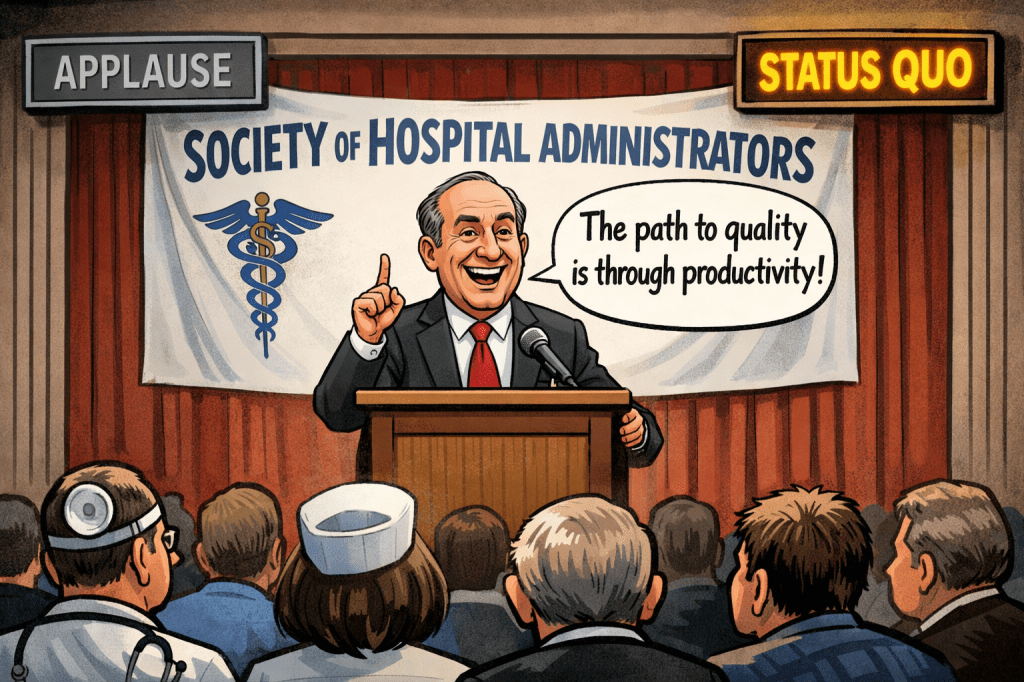
#12: Final point: to be very clear, I’m not slagging-off all clinicians here. I’m just slagging-off those clinicians who regularly slag-off radiologists without having a clue of what the fuck they are talking about. In my view, the COVID pandemic showed us who the real brave souls are — it was the doctors and nurses who faced down that existential threat every single day, which cost more than a few of them their life. My hat’s off to them with hand on a heavy heart. Full stop. One of my friends was head of infectious disease at a Chicago hospital and made it through unscathed, thankfully. A medical school colleague in Baltimore wasn’t so lucky. But those who do not deserve special merit are the countless hospital administrators who sat safely in their offices (or at home) and concocted trite slogans like “Not All Heroes Wear Capes!” You know what, fuck off, you lame assholes!! Too many of you are overpaid, blood-sucking parasites on a system in slow decay. My own physical exposure was relatively limited to doing procedures like lumbar punctures, myelograms, and GI studies on COVID+ patients, which in the pre-vaccine days did cause me moderate anxiety, I admit. At the time when COVID broke out in winter of 2020, I was working at Denver Health where, in a moment of career-defining tone-deafness and absolute callousness, their administrative douchebags had the unmitigated gall to award themselves “contractually-obligated bonuses” (bullshit!) at the very same time they were asking vulnerable frontline workers to take unpaid leave. Needless to say, that didn’t go down so well and was later reversed in shame (or was it??). And if there ever was an incident that underscores the yawning gap in commitment between the hospital administrator — no call, no weekends, no nights, no medico-legal or physical risk = no skin in the game — from the physicians and nurses who do the actual job that the hospital sets out to do, it was this one. And with that, I’ll give agent 98-X the last (fucking) word.
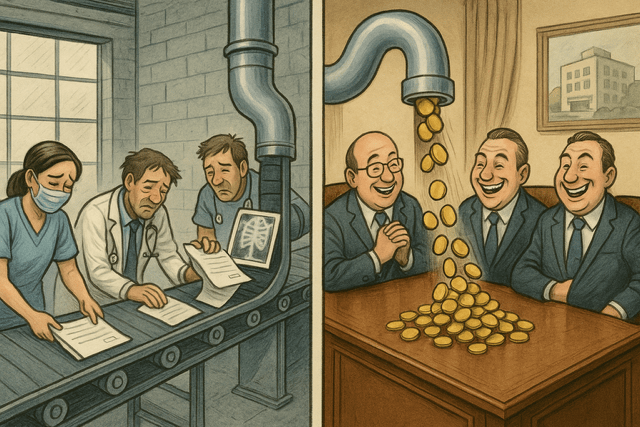
 Great Exudations