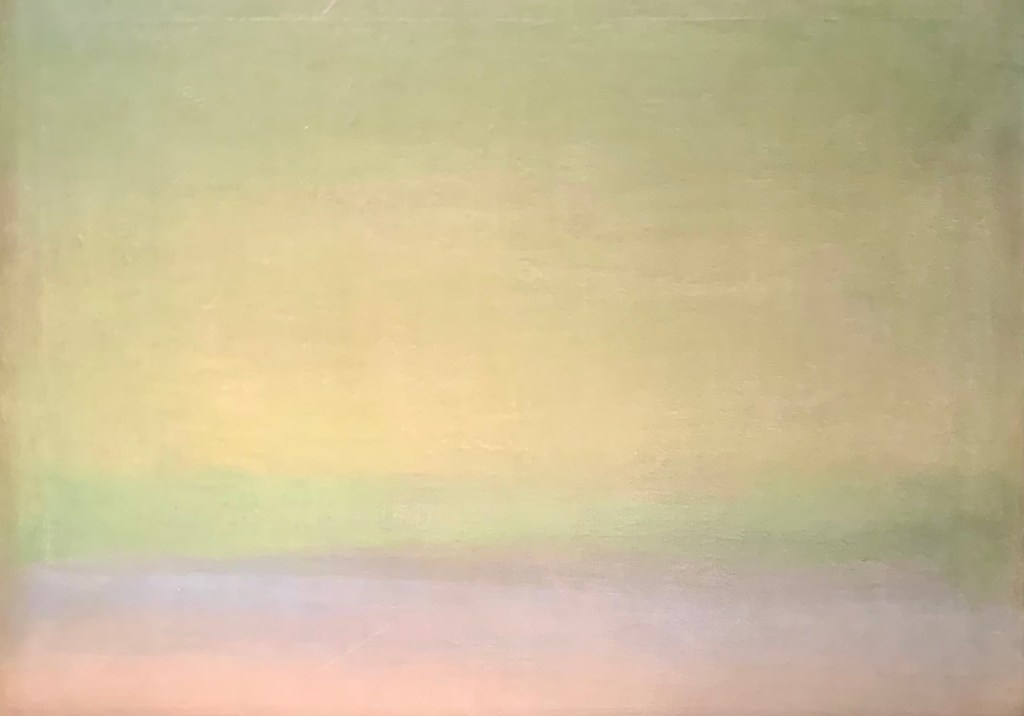
New idea: why not chop up famous works into their smallest auctionable units? I think this half could be passed off as a Rothko-style color field painting and fetch a nice price. With its palette of pastel colors that pulse and suffuse into one another, what’s not to like? Set the reserve price at 7.25 million and let the feeding frenzy begin.
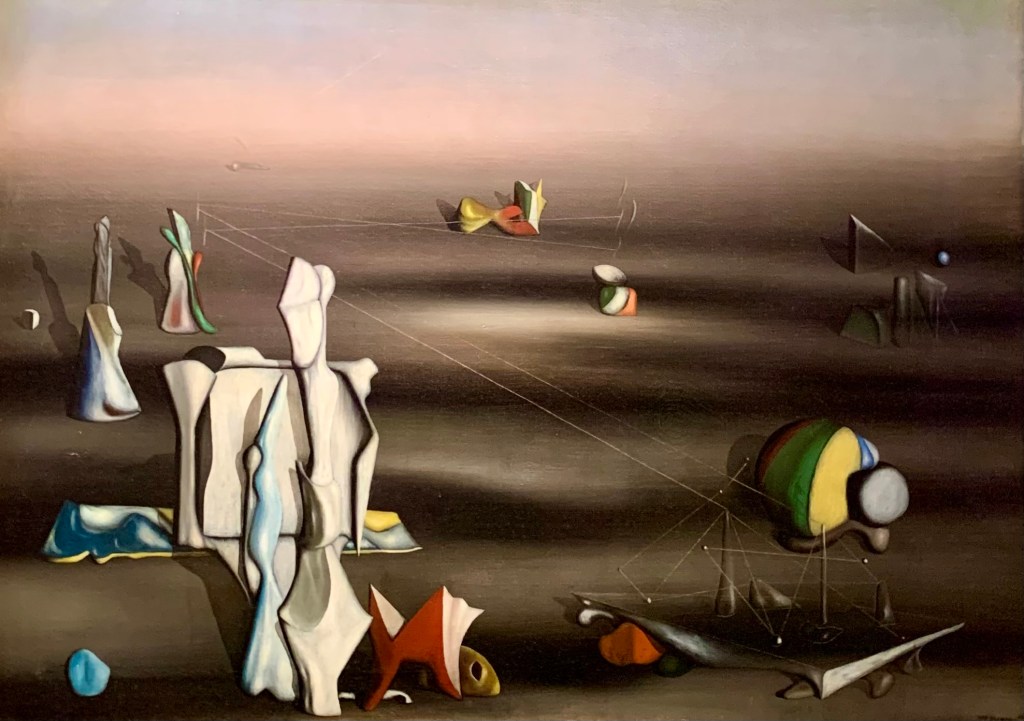
The lower half of this painting has strewn biomorphic forms in a sparse quasi-lunar landscape that the Sotheby’s auction catalog described as “representing a timeless, metaphysical space.” It’s a veritable playground for androids and “Star Trek” nerds — Hieronymus Bosch meets Arthur C. Clarke. We might list this one at 12.75 million for a total take of at least 20 million (minus fees). And who would ever know, as nobody reads this blog!
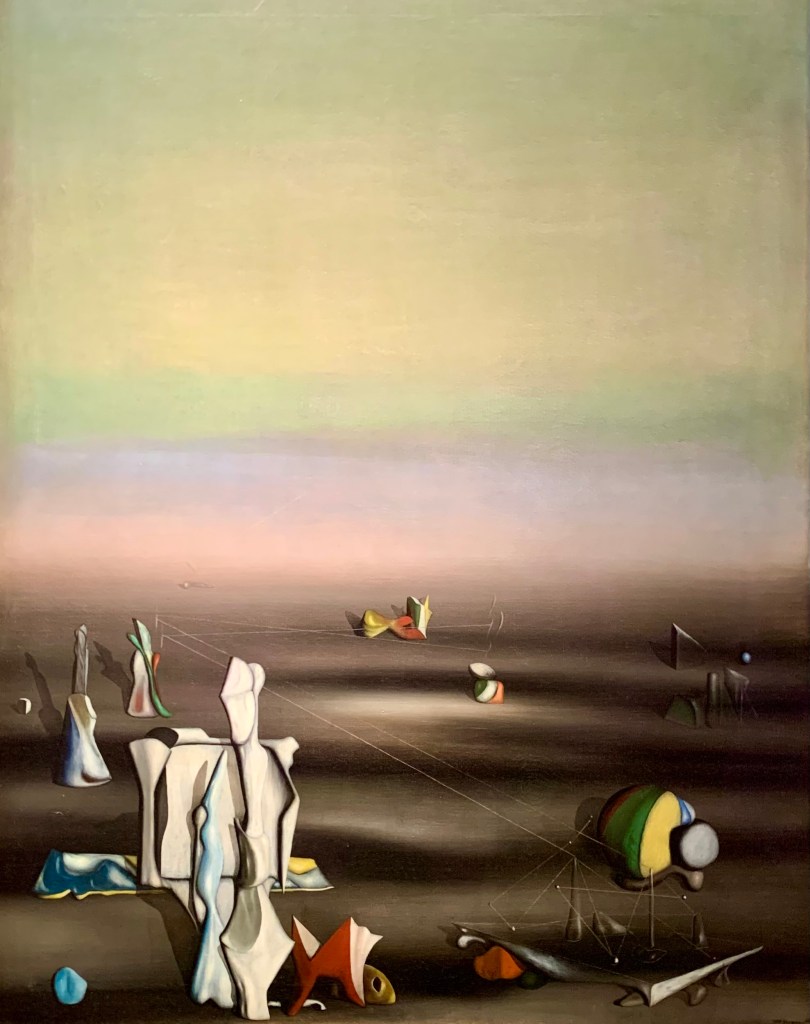
And above is the full-monty, the Tanguy and Tonic. Two pictures in one, for my money. An artful derivative. An aesthetic default swap. AAA rated by Moody’s and S&P. Can’t possibly miss. Unless…
(From Sotheby’s auction website) Yves Tanguy (1900-1955) was a French-American surrealist painter who was invited by Andre Breton in 1925 to join the Surrealist Group. In the 1920’s and 30’s, he developed his distinctive style before emigrating to the United States in 1939 at the outbreak of WWII. Already married at the time, he had a torrid affair with art collector and gallerist Peggy Guggenheim. Their relationship ended with his second marriage to the American artist and poet Kay Sage. They moved to the artists’ colony at Woodbury, Connecticut and there they were surrounded by the likes of Alexander Calder, Andre Masson, and Arshile Gorky. Apparently they got not just heavily into the paints but also the cups. Nothing new there. I’ll bet the sex was messy and hot. Dare say, tangy!
The artist I most commonly mistake Tanguy for is, of course, Salvador Dali. But gone are the teeming ants, the melting clocks, and the flaming giraffes. In this oddscape, we see a world reduced to basic geometric forms of uncertain origin and purpose (not unlike my closet) on a surface where foreground and background meld as one. And while several other artists trafficked in strange glyph-like forms (Joan Miro, Adolph Gottlieb, A. Calder, A. Masson, A. Gorky), I’ve seen only a few that resemble Tanguy’s eerie alt-world lunar-cy. And here we arrive at one of the great joys of the creative world: the personal discovery of a previously unknown artist or band or author or filmmaker who move you in some way and/or add depth to your order and understanding. So with that I give to you, and also to myself, the two female artists Kay Sage and Dorothea Tanning.
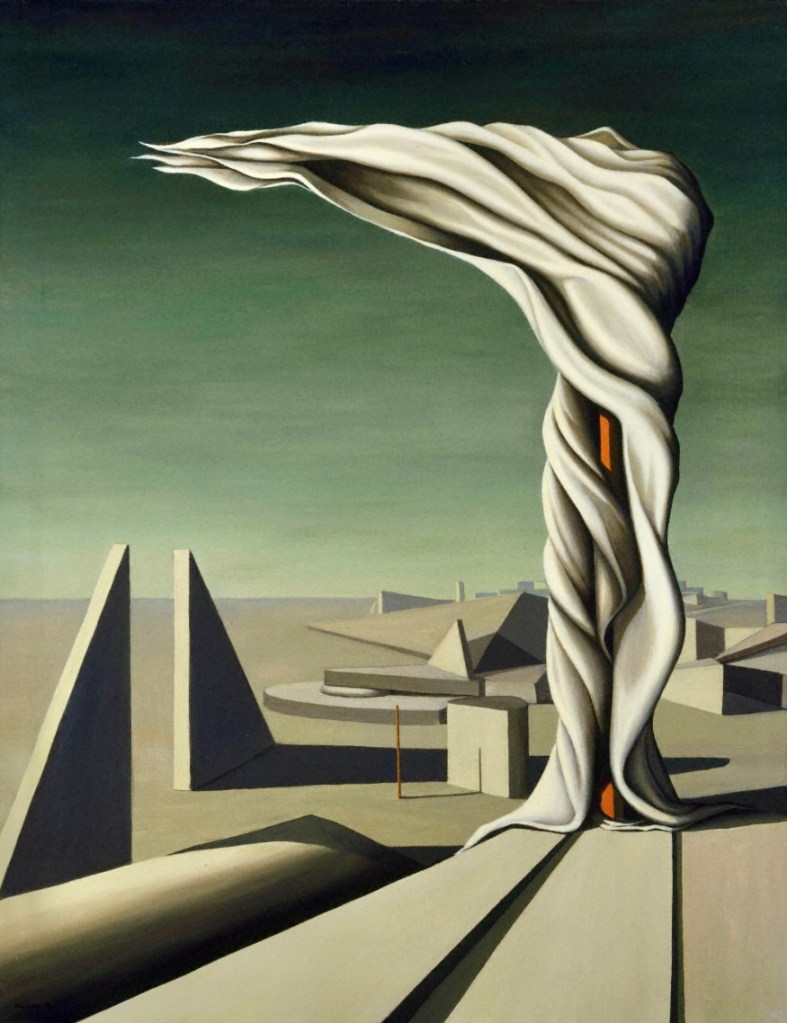

 Great Exudations