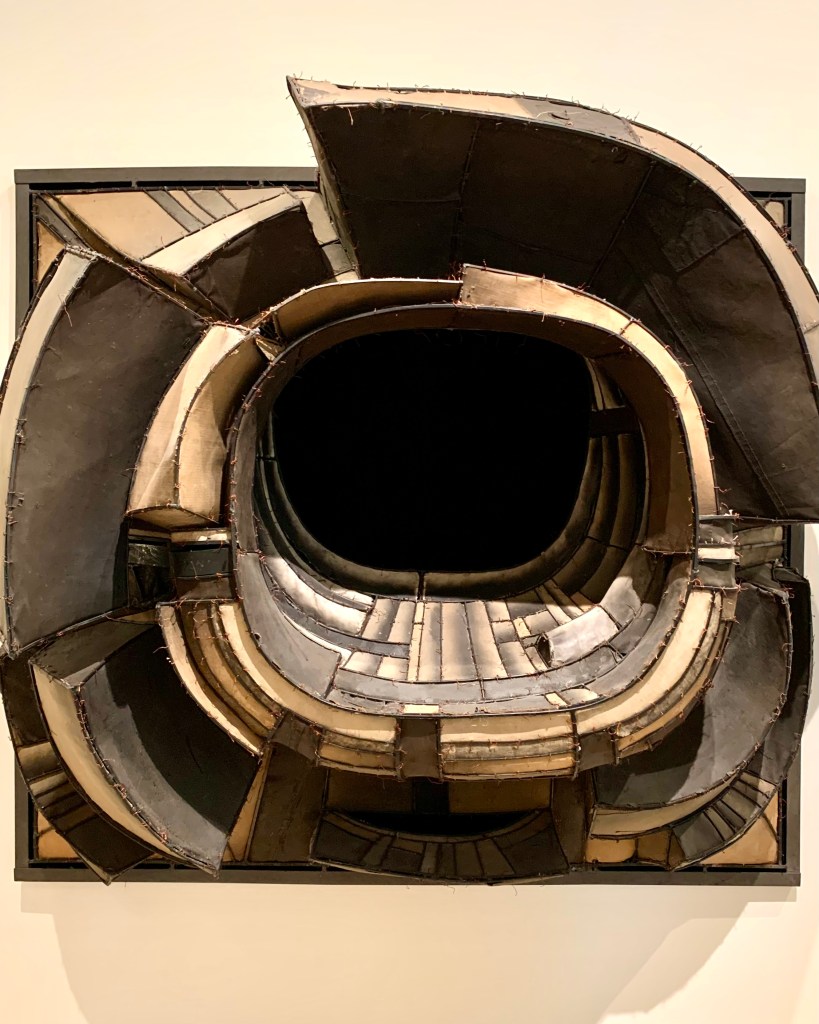
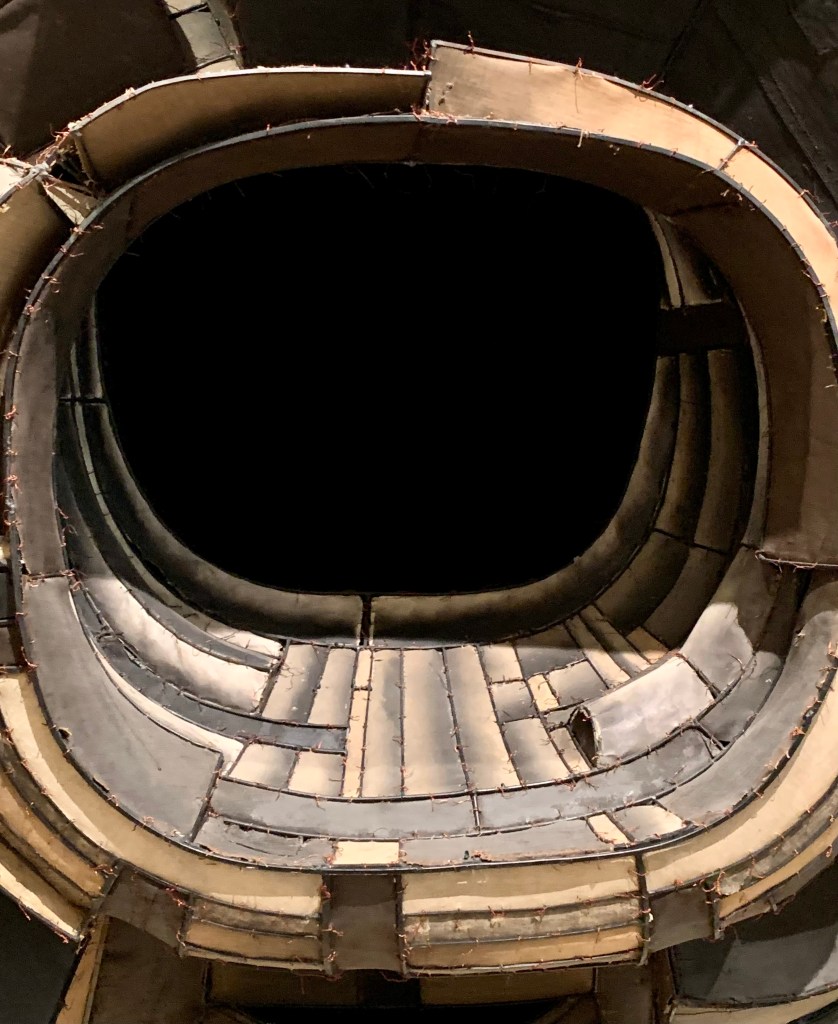


There is something irrepressible about Lee Bontecou’s sculptures in their brutal physicality and heavy 3-dimensionality. For me, they create a simultaneous suction/repulsion, sort of like the air uptakes and exhaust of a jet engine. But for a good while they held just a passing curiosity. It was only after several encounters that I even bothered with the name on the placard and later still that I learned the artist was a woman. But why should this even matter? Well, if my news aggregator is any bellwether, female artists are only recently getting a fraction of their deserved recognition in the art world. This, of course, mirrors slights in other industries. Rosalind Franklin was denied credit for her contributions to the discovery of the DNA double-helix. The film “Hidden Figures” (2017) tells, belatedly, the story of three brilliant African-American women — Mary Jackson, Dorothy Vaughan and Katherine Johnson — who were instrumental in advancing NASA’s early space program. Some women achieved a certain level of acclaim by elbowing into a man’s world, though were not generally household names. Filmmaker Agnes Varda was pioneering in the 50’s and 60’s French New Wave movement, taking a unique perspective on the lives of women, and helping to pave the way for the break-out work of Kathryn Bigelow, Sofia Coppola and Greta Gerwig. And while there are countless successful female authors, the fine arts realm has been particularly withholding in this regard and the major museums and galleries remain largely boys’ clubs. Pause and reflect on your last few art visits and consider how many rooms you passed before encountering a work by Mary Cassatt, Berthe Morisot, Meret Oppenheim, Helen Frankenthaler, Agnes Martin, Martha Rosler, Lee Krasner, Barbara Hepworth or those giant, haunting arachnids of Louise Bourgeois (whereas you “can’t swing a dead cat” without hitting a Calder). Georgia O’Keeffe seems the exception that proves this rule. And, yes, Yayoi Kusama is finally having a moment after toiling in relative obscurity for decades (Louis Vuitton took notice!). In 2021, I saw a really cool exhibit of the fantastic multimedia artist Laurie Anderson at the Hirshhorn Museum in Washington, DC. Other than a Cindy Sherman exhibition at MoMA and the ubiquitous O’Keeffe, there are few others that I recall featuring singular female artists. Perhaps a sea change is upon us. That’s good news for all.
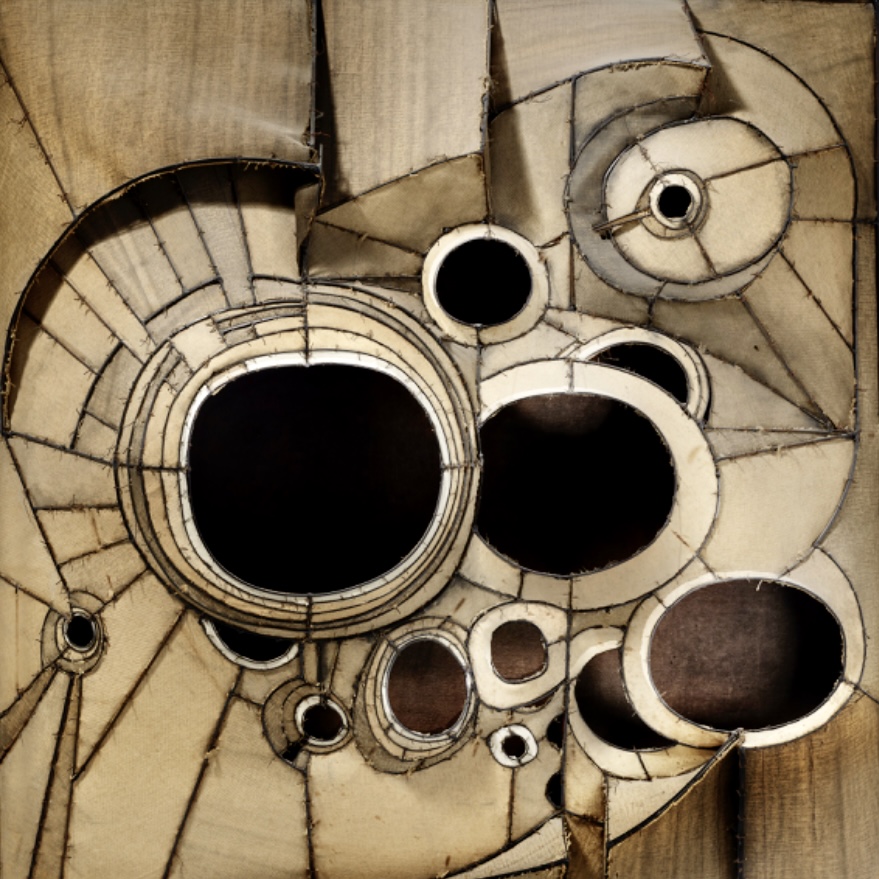
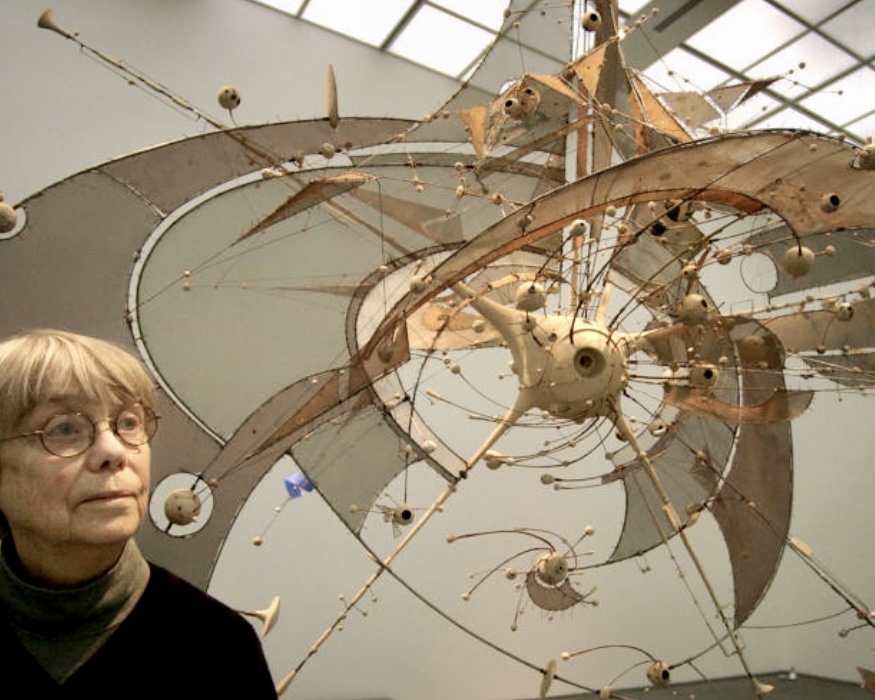
And what about Lee Bontecou (1931-2022)? Well, here’s what I’ve learned from Wikipedia and her New York Times obituary. She was a highly regarded American sculptor who came to public prominence in the 60’s at the famous Leo Castelli Gallery in NYC alongside mostly male artists like Cy Twombly, Frank Stella and Robert Rauschenberg. Inspired by the Abstract Expressionism of her contemporaries, she carved out a signature style of large wall-mounted constructs using industrial materials like conveyor belts, canvas mail bags and pieces of scrap metal. And these abstract constructions were prone, as most abstractions, to broad speculation and projection. Second-wave feminists interpreted the dark cavities as being vaginal and womb-like in their allusion, a concept she flatly negated. Instead, she referenced the influence of Sputnik’s launch in 1959 and the mysteries of outer space as a contact point. For her, art was neither male nor female; it was just art. In her studio, she listened to short-wave radio broadcasts and became incensed by the many reminders of man-made atrocities — the chatter about building bomb shelters, the news of civil wars in Africa, the looming collective memory of the Holocaust — and in that reflection, new implements began to appear in her works formed from gas masks, saw blades and helmets. A brutalist take on man’s own brutality. She chose rivets over ribbons, you might say. It makes for sturdier stuff.
 Great Exudations