
“Paris, Hotel Commodore” by Mother Yingst (1930)
this a wonderful trip
the cemeteries are beautiful
I wish you could see the flowers
everywhere you look love

This is another vintage postcard from a consignment shop in Baltimore. They have loads that are blank but some are hand-scripted and stamped, making them more evocative and alive with narrative possibilities.
But first let’s discuss history. (Per Wikpedia) Chateau-Thierry is a French commune in the Province of Champagne. Tradition holds that the town is named for Theuderic IV (c. 712-737 AD; Thierry being the French translation of Theuderic), the penultimate Merovingian King of the Franks who reigned from the age of 9 until his death. After his demise, the throne (iron?) sat vacant for seven years until Pepin the Short (can’t make this shit up!) arranged for Childeric III to succeed him (wouldn’t seven years without a king make you question the need of one?). Well, it seems that Theuderic’s time there wasn’t a happy one as Charles Martel (aka Charles the Hammer), Mayor of the Palace and de facto ruler of France from 718-741 AD, imprisoned his puppet king in the town. There are castle ruins that date from 720 AD, though it appears that our postcard’s castle was built centuries later. Further along, Chateau-Thierry was sacked by the Prussians during the Napoleonic Wars in 1814. It also saw action in the Battle of the Marne (1918) in WWI and was the high water mark of that German offensive.
Now, let’s look at the postmark. The stamp is a profile of Marcellin Berthelot (who apparently knew a lot), a French chemist and Republican politician. He was convinced that chemical synthesis would revolutionize the food industry by the year 2000 (thereby presaging the Twinkie!). The Thomsen-Berthelot principle (WARNING: this might induce traumatizing flash-backs to high school/college chemistry) states that all chemical changes are accompanied by the production of heat (all that and 90 cents gets you a postage stamp!). And, if I’m reading it correctly, the card was stamped on August 21, 1930. It was a Thursday in France (ha-ha!). And after a little digging I found that on that same day the British Viceroy of India, The Lord Irwin, 1st Earl of Halifax, Edward Frederick Lindley Wood (maybe his friends called him “Deadwood” after he collaborated with Neville Chamberlain on the appeasement of Adolph Hitler) received a letter from Mahatma Gandhi listing the terms by which he would cease his civil disobedience campaign. And there was other news that same month from around the world:
— British rigid airship (called “Zeppelins” in Germany) R100 completed an Atlantic crossing from Cardington, UK to Montreal, Canada in 78 hours, 51 minutes, a new speed record. The Concorde of its day!
— Jack Zuta, mob accountant and “fixer” who worked for Al Capone but then crossed over to Bugs Moran‘s North Side Gang was shot dead while in hiding near Milwaukee for the murder of Chicago Tribune reporter Jack Lingle.
— King Kullen, per the Smithsonian Institution the first supermarket in the US, was founded by Michael Cullen, a former Kroger employee, in the Queens borough of NYC. It fulfilled all five criteria of a modern supermarket: separate departments, self-service, discount-pricing, chain-marketing, and volume dealing. Within wo years, the company had eight stores.
— President Herbert Hoover holds a press conference to announce that General Douglas MacArthur (“D-Mac” to his cronies) was appointed as Chief of Staff of the US Army.
— Neil Armstrong was born in Wapakoneta, Ohio on Aug 5, 1930.
— Cartoon character Betty Boop made her first appearance in the short film “Dizzy Dishes”
— The Noel Coward play “Private Lives” opened at King’s Theater, Edinburgh.
— Actor Lon Cheney, “The Man of a Thousand Faces,” died on Aug 26, 1930 from lung cancer.
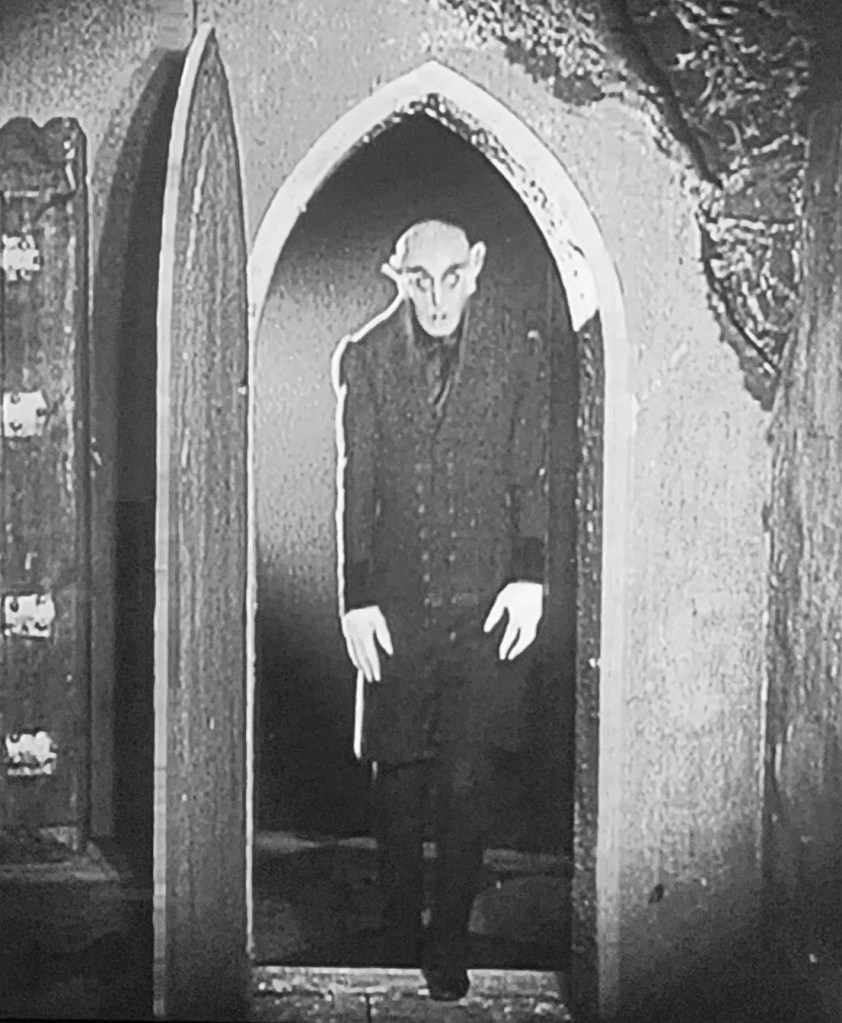
Now to the photograph itself. A Medieval castle of Europe in sepia tones can’t help but evoke F.W. Murnau‘s silent-era film “Nosferatu” (1922). As it turned, despite changing the vampire’s name to Count Orlok and other various shifts in plot, the filmmakers were successfully sued by the heirs of Bram Stoker for infringing on his “Dracula.” A court held that all copies must be destroyed. However, several prints survived and the film went on to be one of the most influential of all time, spawning numerous copycats and variations. So go ahead, steal. Or rather, pay homage (they might have called it “From Prussia With Love!”). But I have a slightly different story in mind from this postcard image. Our Count Orlok is ugly and sinister in appearance, of course. But he is mute. And would you believe also benevolent. He is keeping a beautiful princess in his castle against her will, but not for reasons you would otherwise imagine. It is to protect her from the handsome bachelor Prince Vandillon, a knight of the realm who has pledged his undying love for the lady. But unbeknownst to her, this dapper figure is a vile ogre named Dungolla, in disguise by means of a witch’s spell (she goes by many names, too numerous to list here). And his half-brother, Count Orlok, was rendered disfigured and silenced by the very same spell at the behest of his rival. And now maybe you can help me finish the tale. I think Orlok dies, but he does so setting the maiden free and vanquishing the hag-sorceress and her warty accomplice…. (to be continued).
 Great Exudations