
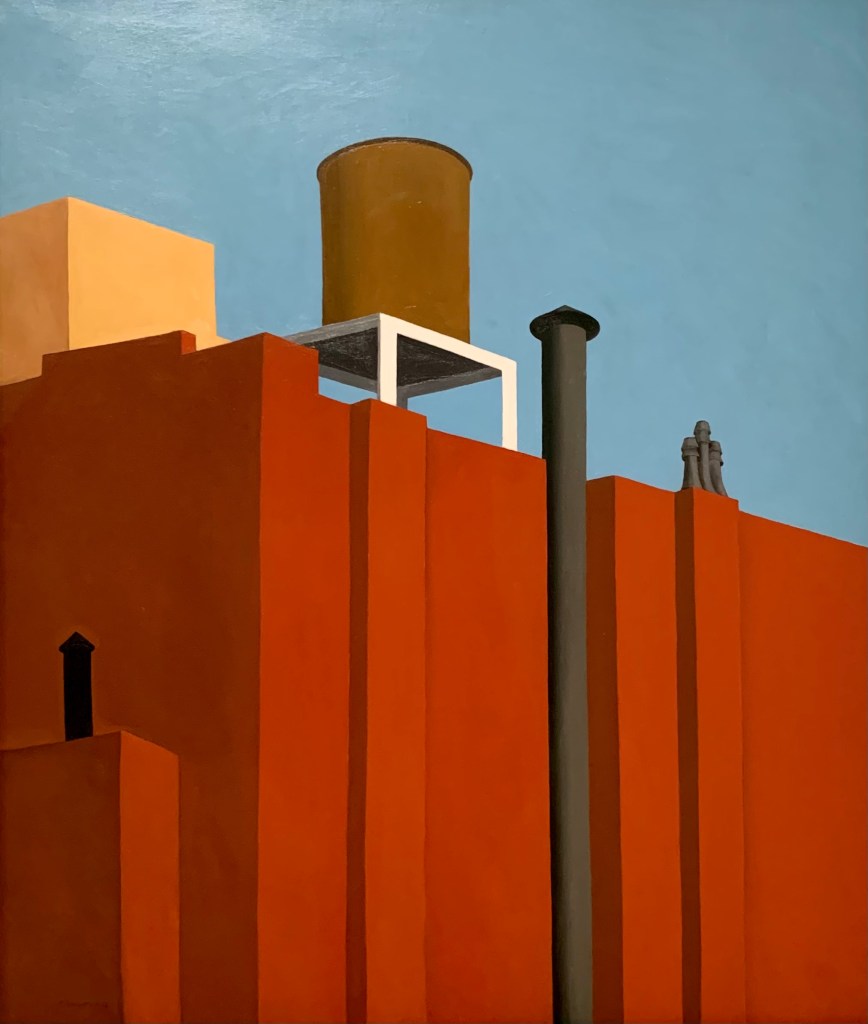
This scene brought to mind the American artist Charles Sheeler (1883-1965), whose works I’ve gradually come to enjoy. His scenes are clean and uncluttered, being of the Precisionist school of modern art that depicted an idealized form of industrialism. Known for painting so-called “immaculates,” this group of artists (also George Ault, Ralston Crawford, Charles Demuth and Georgia O’Keeffe) reduced skyscrapers and factories to their very essence. Pleasing lines and color palette, all simplified, in the way our own memories might. Sheeler was also a notable photographer and filmmaker, and he was pioneering in his use of captured still images as the basis for his art. His imagery (and that of his cohort), to me, is similar to Edward Hopper — but crucially stripped of the human frailty and melancholia that so characterizes the latter. In that way, they work in tandem. Obverse and reverse. Timeless, while also dated. The hopefulness of technical progress pitted against the limitations of man himself.

 Great Exudations